

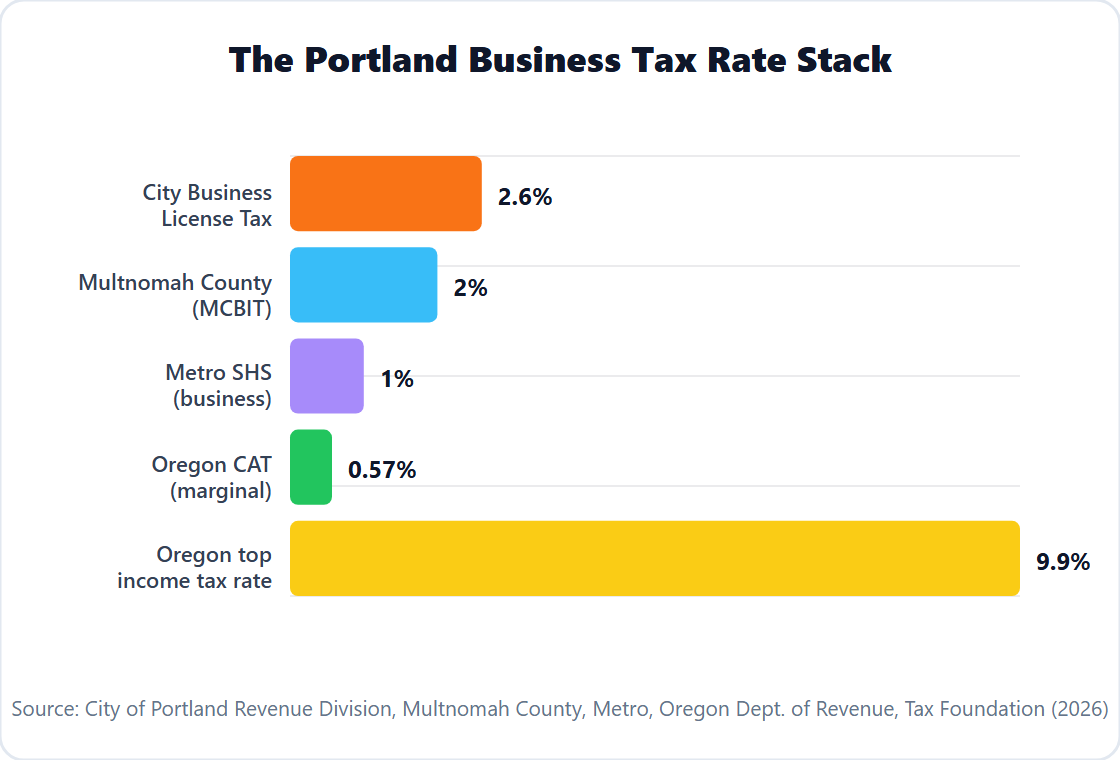
A Portland small business can owe tax at four different levels: city, county, regional, and state. Oregon’s overall tax competitiveness ranking has slid from 8th in the nation in 2020 to 35th in 2026. Much of that shift traces to how these layers stack on top of one another in the Portland area (Tax Foundation, 2026 State Tax Competitiveness Index).
This guide breaks down each tax a Portland business owner needs to know for 2026. It covers what each tax applies to, the current exemption thresholds, and how the pieces interact for pass-through owners. Every figure below is sourced directly to the issuing government agency: the City of Portland Revenue Division, Multnomah County, Metro, and the Oregon Department of Revenue.
Key Takeaways
- Portland businesses can face up to five tax layers: City Business License Tax, Multnomah County Business Income Tax (MCBIT), Metro Supportive Housing Services (SHS) tax, Oregon’s Corporate Activity Tax (CAT), and Oregon personal/pass-through income tax.
- Small businesses are exempt from several of these at low revenue: City tax exempts gross receipts of $75,000 or less, MCBIT exempts under $100,000, and Metro SHS business tax only applies above $5 million.
- Pass-through owners (LLC, S-corp, sole proprietor) can trigger personal add-on taxes from both Metro SHS and Multnomah’s Preschool for All (PFA) once taxable income passes $125,000 (single) or $200,000 (joint).
- Oregon has no state sales tax, but the Corporate Activity Tax is a gross-receipts-style tradeoff that kicks in once Oregon-sourced commercial activity exceeds $750,000.
In this article:
- The Five Taxes a Portland Small Business May Owe
- Portland Business License Tax
- Multnomah County Business Income Tax (MCBIT)
- Metro Supportive Housing Services (SHS) Tax: Business and Personal
- Multnomah County Preschool for All (PFA) Personal Income Tax
- Oregon Corporate Activity Tax (CAT) and State Income Tax
- What This Looks Like at Different Revenue Levels
- Filing Deadlines, Penalties, and Getting Help
- Frequently Asked Questions
- Conclusion
The Five Taxes a Portland Small Business May Owe
Every Portland business potentially touches five separate tax authorities, each with its own rate, base, and exemption threshold:
- City of Portland Business License Tax — 2.6% of net business income earned within city limits
- Multnomah County Business Income Tax (MCBIT) — 2% of net business income, administered together with the city tax
- Metro Supportive Housing Services (SHS) tax — a regional tax with both a business leg (1% of net income) and a personal leg (1% on high individual incomes)
- Oregon Corporate Activity Tax (CAT) — a state gross-receipts-style tax on commercial activity above $1 million
- Oregon personal or pass-through income tax — standard state income tax brackets, relevant to sole proprietors, LLC members, and S-corp owners whose business income flows to their personal return
Most small businesses will not owe all five — the exemption thresholds below are calibrated to leave truly small operations out of the city, county, and regional business taxes entirely.

Portland Business License Tax
The City of Portland Business License Tax is 2.6% of net income from business activity conducted within city limits (City of Portland Revenue Division). For 2026, businesses with gross receipts of $75,000 or less from all sources — both inside and outside the city — are exempt. That threshold rises to $100,000 starting in tax year 2027, under Ordinance 192163.
Consider Maria, who runs a small coffee shop in Southeast Portland. In her first year, the shop brings in $68,000 in gross receipts — under the $75,000 exemption, so she owes no City Business License Tax yet. By her third year, sales grow to $95,000. She now crosses the threshold, registers with the Revenue Division, and files a return on her net income going forward.

Businesses above the exemption threshold must register with the Revenue Division and file an annual return, generally alongside their Multnomah County return since the city administers both. Net income, not gross revenue, is the taxable base, so ordinary business expenses reduce the amount actually taxed.
Multnomah County Business Income Tax (MCBIT)
Multnomah County’s Business Income Tax (MCBIT) is 2% of net business income (Multnomah County). Businesses with gross receipts under $100,000 from all sources are exempt. That threshold has applied since 2020.
The City of Portland Revenue Division administers MCBIT on the county’s behalf. Most businesses file both the city and county returns together on the same combined form: one filing, two separate taxes, each calculated at its own rate and threshold.
Metro Supportive Housing Services (SHS) Tax: Business and Personal
Metro’s Supportive Housing Services tax is unusual because it has two distinct legs, and pass-through business owners can be affected by both.
The business leg applies a 1% tax on net income, but only to businesses with gross receipts over $5 million everywhere — a threshold high enough that most small businesses are exempt outright. That $5 million threshold began adjusting for inflation (CPI) starting in tax year 2026 (Metro).
The personal leg is where owners of profitable small businesses can get caught, even if their business itself is too small for the business-leg tax. Metro adds 1% on an individual’s Metro taxable income above $125,000 (single filers) or $200,000 (joint filers). Pass-through business income — from an LLC, S-corp, or sole proprietorship — flows onto the owner’s personal return. That means a single profitable year can trigger this tax, even for a business well under the $5 million business threshold.
Multnomah County Preschool for All (PFA) Personal Income Tax
Multnomah County’s Preschool for All tax runs alongside the Metro SHS personal tax and uses the same starting thresholds. It adds 1.5% on county taxable income above $125,000 (single) or $200,000 (joint), stepping up to a combined 3% on income above $250,000 (single) or $400,000 (joint) (Multnomah County). A previously scheduled rate increase (to 2.3%/3.8%) has been delayed from January 2026 to January 2027.
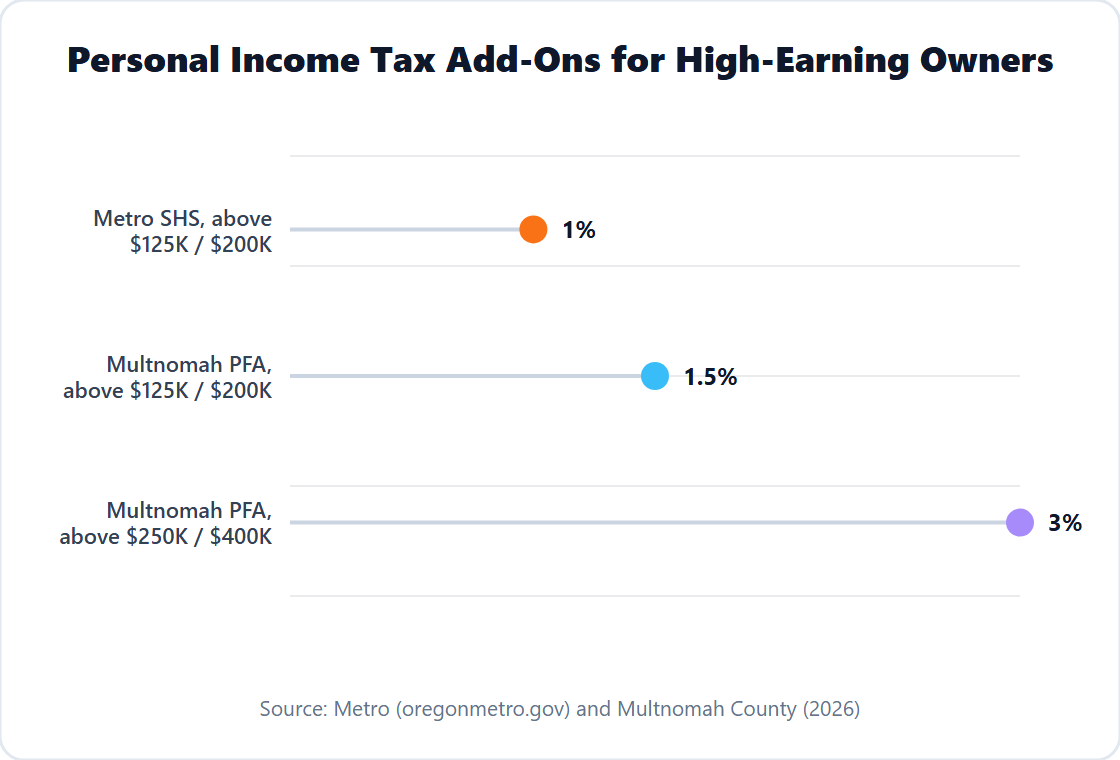
For pass-through owners, PFA and Metro SHS personal tax can both apply to the same dollar of business income once it crosses these thresholds — a detail that’s easy to miss when only researching the business-level taxes. Both jurisdictions also raised their estimated-quarterly-payment trigger from $1,000 to $5,000 in expected liability starting in 2026, which reduces paperwork for owners closer to the threshold.
Oregon Corporate Activity Tax (CAT) and State Income Tax
The Oregon Corporate Activity Tax (CAT) is a state-level tax on commercial activity (Oregon Department of Revenue). It costs $250 plus 0.57% of taxable Oregon commercial activity above $1 million. Registration is required within 30 days of exceeding $750,000 in Oregon-sourced commercial activity. Missing that registration deadline carries a penalty of up to $100 per month, capped at $1,000 per year.
Separately, business income that passes through to an owner’s personal return is taxed under Oregon’s regular income tax brackets. Single filers pay 4.75% up to $4,050, 6.75% from $4,050 to $10,200, 8.75% from $10,200 to $125,000, and 9.9% above $125,000 (joint-filer thresholds are roughly double). These brackets are not indexed for inflation.
Oregon has no state sales tax — one of five states nationwide without one. That shifts more of the state’s revenue burden onto income and activity-based taxes like the CAT (Tax Foundation).

What This Looks Like at Different Revenue Levels
These are illustrative examples only, not published statistics — no single source states a blended “effective rate,” since each tax applies to a different base and threshold.
| Gross receipts | City Business License Tax | MCBIT | Metro SHS (business) | Oregon CAT | Notes |
|---|---|---|---|---|---|
| $50,000 | Exempt (under $75K) | Exempt (under $100K) | Exempt (under $5M) | Far under $750K trigger | Likely owes none of the four business-level taxes |
| $150,000 (owner nets $130,000) | Owed | Owed | Exempt (under $5M) | Under $750K trigger | Owner’s personal income may also cross the $125,000 Metro SHS/PFA personal-tax thresholds |
| $2,000,000 | Owed | Owed | Exempt (under $5M) | Registration required if commercial activity exceeds $750K | Common to cross the CAT registration trigger at this size — worth checking |
| $10,000,000 | Owed | Owed | Owed (over $5M) | Owed | Likely owes all four business-level taxes, plus state income tax on any pass-through owner income |
Filing Deadlines, Penalties, and Getting Help
Late payment of Portland Business License Tax carries a 5% penalty on the unpaid amount. That penalty rises by an additional 20% if the tax remains unpaid for four months or more. Interest also accrues at roughly 10% per year — about 0.833% per month — from the original due date (City of Portland Municipal Code 7.02.700, 7.02.710).
Given how many separate thresholds and rates are in play, a bookkeeper or CPA familiar with Portland’s specific tax stack is often worth the cost once a business crosses even one exemption threshold — filing errors across five overlapping jurisdictions compound quickly. Clean, consistent bookkeeping throughout the year is what makes tracking these thresholds manageable in the first place; see our what is bookkeeping? a small business owner’s guide for the fundamentals.
Frequently Asked Questions
Does my Portland business have to pay all five taxes?
No. Most small businesses are exempt from at least the City Business License Tax (under $75,000 gross receipts), MCBIT (under $100,000), and Metro SHS business tax (under $5 million) — the state-level CAT and income tax are the ones most businesses eventually encounter as they grow.
What’s the minimum revenue before I owe any city or county tax?
For 2026, the City of Portland exempts gross receipts of $75,000 or less, and Multnomah County exempts gross receipts under $100,000. Below those figures, a business generally owes neither the City Business License Tax nor MCBIT.
Do I still need to file if I’m under the exemption threshold?
Registration requirements can apply even when a business ultimately owes no tax; check current filing instructions from the City of Portland Revenue Division for your specific situation, since exemption from tax and exemption from filing aren’t always the same thing.
How does Oregon have no sales tax but still tax businesses this much?
Oregon offsets the lack of a sales tax with income-based and gross-receipts-style taxes instead, including the state Corporate Activity Tax and Portland’s stack of local business taxes — the revenue comes from a different base, not from a lower overall burden.
What happens if I miss the Oregon CAT registration deadline?
Businesses that exceed $750,000 in Oregon-sourced commercial activity must register within 30 days; missing that deadline carries a penalty of up to $100 per month, capped at $1,000 per year, separate from any tax owed once the $1 million activity threshold is crossed.
Conclusion
A Portland small business’s tax picture depends heavily on scale: below roughly $75,000–$100,000 in gross receipts, most city and county business taxes don’t apply at all, while pass-through owners crossing $125,000 in personal income can trigger Metro and Multnomah add-on taxes even when their business itself stays well under the larger thresholds. Watch the 2027 changes already on the books — the City exemption threshold rising to $100,000 and the Multnomah PFA rate increase — since both shift the math for businesses sitting near today’s cutoffs.
If you’re approaching any of these thresholds, a Portland-based bookkeeper or CPA can map your specific numbers against all five layers before a filing deadline puts you at risk of the penalties above.
Navigate Portland & Oregon Taxes with Confidence
Enter And Post LLC provides professional federal, Oregon state, Multnomah County, and City of Portland tax preparation and filing starting at $300 flat rate. Headquartered in Portland, Oregon 97219, our certified advisory team ensures 100% compliance with both the IRS and the Oregon Department of Revenue.
Explore Portland Tax Services Book a Free 15-Minute Tax Review