

For an Oregon business owner, few tax decisions promise bigger savings than electing S-Corporation tax status for your LLC. But few decisions carry as many compliance traps, payroll rules, and surprise state fees if executed too early or incorrectly.
As an Oregon single-member LLC or partnership, 100% of your business net profit is subject to the federal 15.3% self-employment tax (FICA) on top of your federal and Oregon income taxes. By making a timely S-Corporation election (IRS Form 2553), you can divide your earnings into a W-2 reasonable salary (subject to payroll tax) and shareholder distributions (100% exempt from self-employment tax).
This guide breaks down exactly how the math works in Oregon for 2026 and 2027, the exact net profit “tipping point” where an S-Corp pays off, IRS reasonable compensation rules, and the Oregon state-specific rules (including the $150 minimum excise tax, TriMet transit tax, and Paid Leave Oregon) you must navigate.
Key Takeaways
- The $60,000 Profit Tipping Point: In Oregon, electing S-Corp status rarely saves money below $50,000 in annual net profit due to payroll administrative costs, corporate tax return preparation (Form 1120-S), and the Oregon $150 minimum corporate excise tax. Above $60,000, savings compound rapidly.
- At $100,000 Net Profit: An Oregon S-Corp owner paying themselves a reasonable $50,000 salary saves approximately $5,280 in net cash every year after all payroll and tax filing expenses.
- Reasonable Compensation Is Mandatory: The IRS strictly audits zero-salary or artificially depressed wages (Revenue Ruling 59-221). The “60/40 rule” is an industry myth; compensation must reflect market replacement value.
- Oregon State Compliance: An S-Corp requires running payroll through the Oregon Employment Department (Form OQ / Form 132), paying the $150 Oregon corporate minimum excise tax, and managing Paid Leave Oregon and TriMet transit taxes.
- Deadline for S-Election: Form 2553 must be filed within 2 months and 15 days of the start of the tax year (March 15 for calendar year entities), or qualify under late-election relief (IRS Rev. Proc. 2013-30).
In this article:
- • How an S-Corp Saves Taxes (The Self-Employment Arbitrage)
- • The Real Math: LLC vs. S-Corp at $100,000 Profit
- • The Oregon S-Corp Profit Tipping Point ($60k)
- • IRS Reasonable Compensation Rules & Audit Traps
- • Oregon-Specific Taxes & Compliance Requirements
- • Deadlines, Form 2553 & Late-Election Relief
- • The Real Costs: Payroll, Bookkeeping & Form 1120-S
- • Frequently Asked Questions
- • How to Decide for Your Business
How an S-Corp Saves Taxes (The Self-Employment Arbitrage)
An S-Corporation is not a business entity created with the Oregon Secretary of State; it is a federal tax classification elected by an existing LLC or Corporation. By default, a single-member LLC is taxed as a disregarded entity (sole proprietorship on Schedule C), and a multi-member LLC is taxed as a partnership (Form 1065).
Under default LLC taxation, the IRS considers all active trade or business earnings to be self-employment income. You pay a combined 15.3% self-employment tax (12.4% Social Security up to the wage base limit plus 2.9% Medicare) on 92.35% of your net profits, before federal and Oregon state income taxes ever kick in.
When your LLC elects S-Corporation status under Subchapter S of the Internal Revenue Code, your business profit is split into two distinct streams:
- W-2 Shareholder-Employee Wages: Subject to standard payroll withholdings (Social Security, Medicare, Oregon state income withholding, and Paid Leave Oregon).
- Shareholder Dividend Distributions: Paid to you from remaining corporate profits. Distributions pass through to your personal return on Schedule K-1 and are 100% exempt from the 15.3% self-employment tax.

The Real Math: LLC vs. S-Corp at $100,000 Profit
To understand why Oregon business owners elect S-Corp status, let us examine an active service business (consultant, trades contractor, or creative agency) generating $100,000 in net business profit.
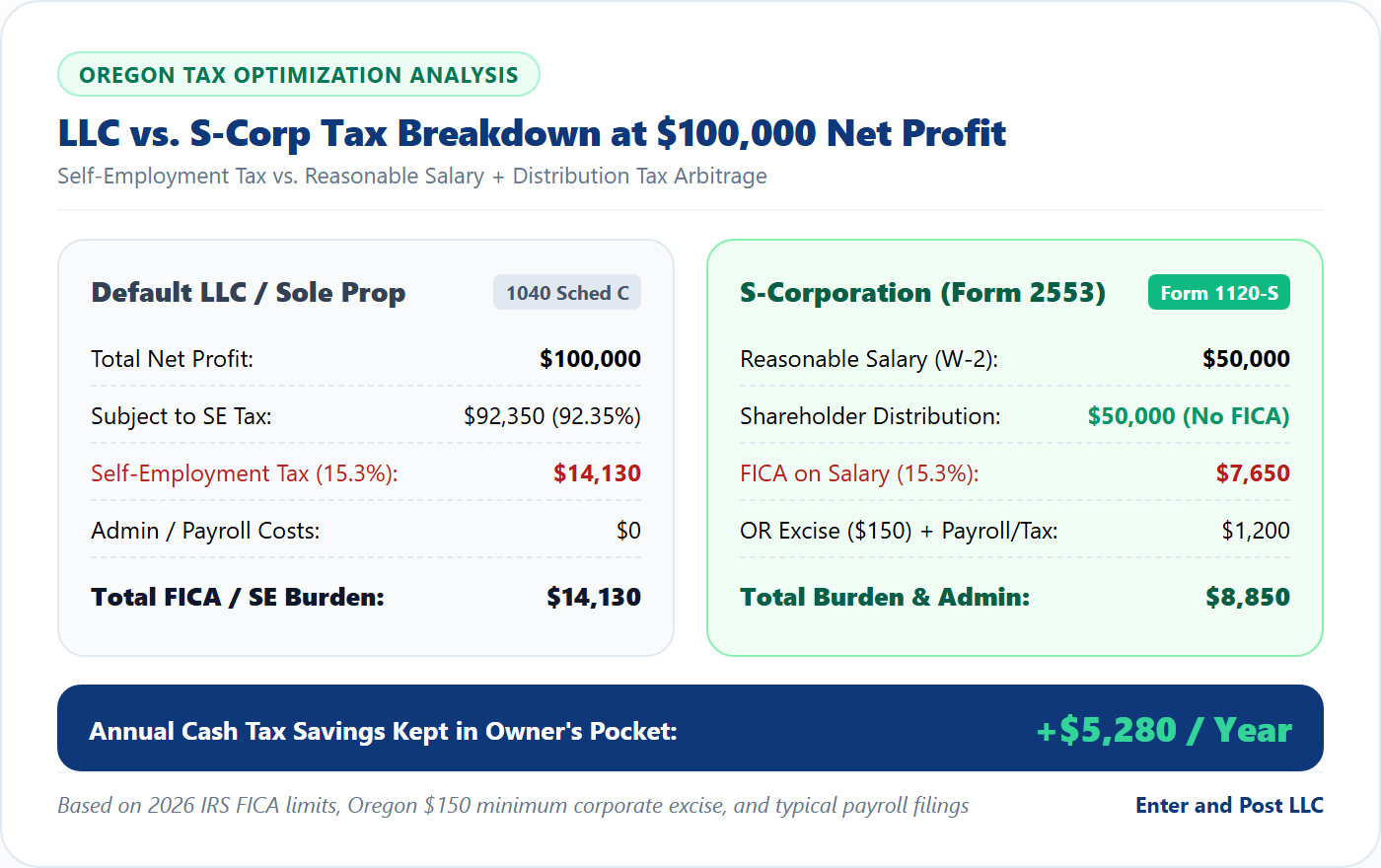
| Line Item | Default LLC (Schedule C) | S-Corporation (Form 1120-S) | Variance / Savings |
|---|---|---|---|
| Net Business Profit | $100,000 | $100,000 | $0 |
| W-2 Owner Salary | $0 (Cannot be W-2) | $50,000 | — |
| Shareholder Distribution | $100,000 (Owner Draw) | $50,000 | — |
| Self-Employment / FICA Tax | $14,130 (15.3% on 92.35%) | $7,650 (15.3% on $50k) | +$6,480 Saved |
| Oregon Corporate Minimum Excise | $0 | -$150 | -$150 |
| Payroll Admin & S-Corp Tax Return | $0 | -$1,050 (approx.) | -$1,050 |
| Net Cash In Owner’s Pocket | Baseline | +$5,280 Net Cash Kept | +$5,280 / Year |
By saving $6,480 in gross self-employment taxes and paying roughly $1,200 in total additional Oregon and administrative fees, the owner puts over $5,200 in net cash back into their bank account every single year. Over 5 years of operations, that is $26,000+ in retained equity.
The Oregon S-Corp Profit Tipping Point ($60k)
If an S-Corp saves money, why doesn’t every new business elect it on day one? The answer is overhead drag. Running an S-Corp requires maintaining separate payroll filings, paying Oregon unemployment insurance, filing an annual federal Form 1120-S corporate tax return, and paying the $150 Oregon corporate minimum excise tax.
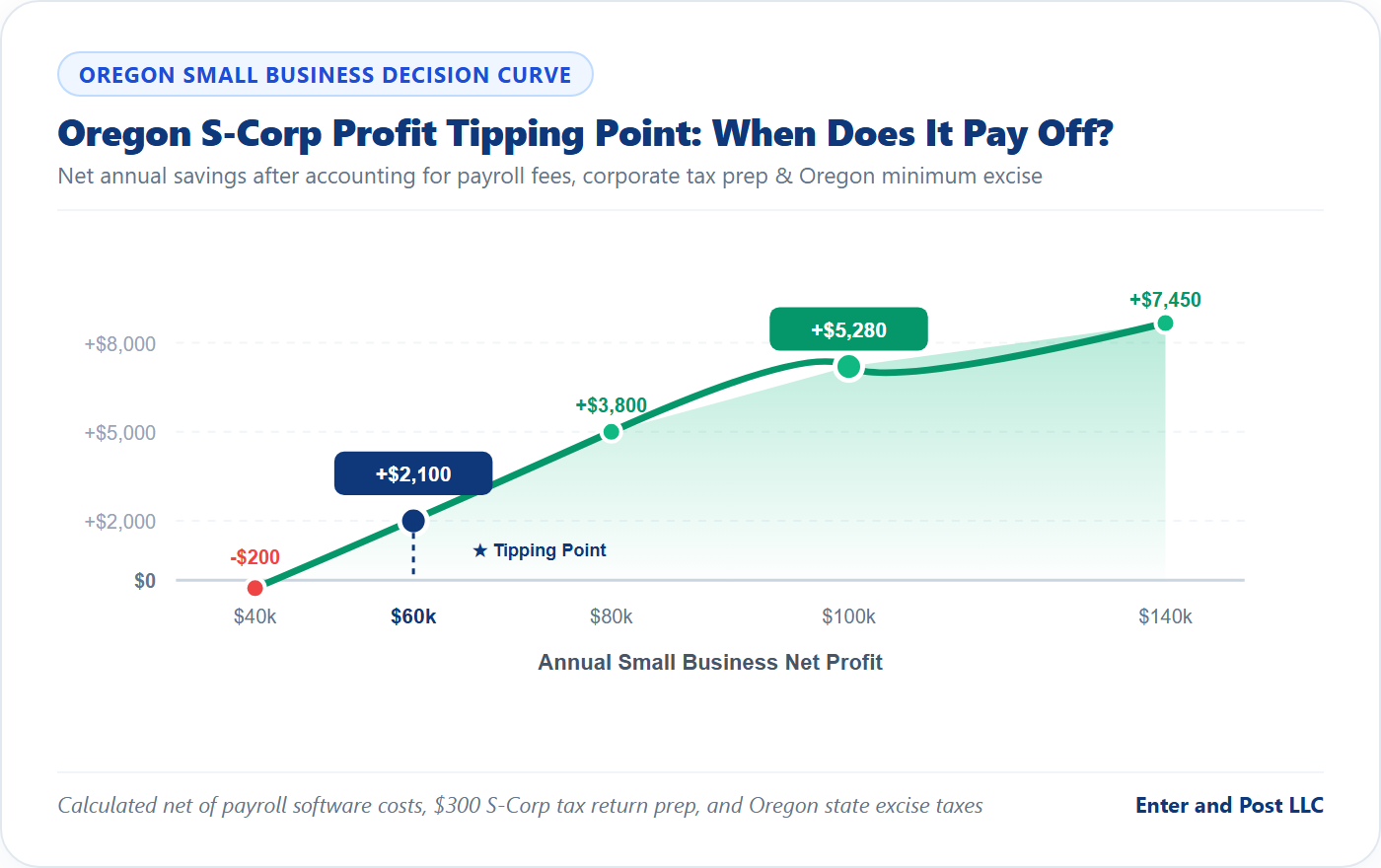
In Oregon, the true tipping point sits right around $55,000 to $60,000 in net profit:
- Under $40,000 Profit: Do not elect S-Corp. If your net profit is $40,000 and reasonable salary is $30,000, you only save FICA on $10,000 ($1,530 saved). After paying $1,200 to $1,500 in payroll processing, corporate tax preparation, and state fees, your net savings are essentially zero or negative.
- $60,000 Profit (The Tipping Point): At $60,000 profit ($35k salary / $25k distribution), gross tax savings reach ~$3,800. After administrative costs, you pocket about +$2,100 clean cash savings.
- $100,000+ Profit: The election becomes an absolute no-brainer, yielding $5,200 to $7,500+ in annual savings.
IRS Reasonable Compensation Rules & Audit Traps
The single biggest audit risk for an S-Corporation is unreasonable compensation. Because distributions avoid payroll tax, aggressive business owners often try to pay themselves a tiny $10,000 salary and take $90,000 in distributions.
Under IRS Revenue Ruling 59-221 and Internal Revenue Code Section 1402, court precedents make clear that shareholder-employees must be paid “reasonable compensation” for the fair market value of services rendered before any distribution can be taken. If audited, the IRS can reclassify your entire distribution as wages, assessing back payroll taxes, failure-to-withhold penalties, and interest.
⚠️ The 60/40 Rule Is a Dangerous Myth
Many online forums claim you can automatically allocate 60% of profits to salary and 40% to distributions. The IRS does not recognize any percentage rule. Reasonable compensation is evaluated based on: (1) training and experience, (2) duties and responsibilities, (3) time and effort devoted to the business, (4) comparable salaries in your geographic area (e.g., Portland metro BLS wage surveys), and (5) whether the business is capital-intensive or service-intensive.
For solo service providers (where 100% of revenue is generated by the owner’s personal labor), salary must represent a realistic replacement cost—what it would cost to hire someone with your skills in Portland to perform those services.
Oregon-Specific Taxes & Compliance Requirements
Electing S-Corp status in Oregon introduces unique state and local tax obligations that national guides ignore:
- Oregon Minimum Corporate Excise Tax ($150): Even though S-Corporations are pass-through entities federally, the State of Oregon levies an annual minimum excise tax under ORS 317.090. For Oregon sales under $1 million, the tax is a flat $150 per year (filed on Oregon Form OR-20-S).
- Oregon Combined Payroll Reporting (Form OQ & Form 132): Once you pay yourself W-2 wages, your business must register with the Oregon Employment Department for an Oregon Business Identification Number (BIN) and file quarterly payroll reports.
- TriMet Transit District Tax (0.8037%): As an employer in the Portland metropolitan area, you must pay TriMet transit taxes on gross employee wages. For an LLC, transit tax is paid on net self-employment earnings via Schedule SE; for an S-Corp, it shifts to quarterly employer payroll reporting.
- Paid Leave Oregon & Workers’ Benefit Fund (WBF): S-Corp shareholder-employees are considered statutory employees under Oregon law. The 1% Paid Leave Oregon contribution (0.6% employee withhold, 0.4% employer share if over 25 employees) applies to your W-2 wages. See our Portland payroll tax guide for step-by-step rates.
- City of Portland & Multnomah County Business Taxes: Portland imposes a 2.6% Business License Tax and Multnomah County imposes a 2.0% Business Income Tax. While both apply to net business income regardless of entity type, compensation paid to owners is subject to specific state and county add-back rules.
- Oregon Pass-Through Entity Alternative Tax (PTE-E / Senate Bill 727): Oregon allows qualifying S-Corporations to pay state income tax at the entity level, allowing owners to deduct state income taxes as a federal business expense—bypassing the $10,000 federal SALT deduction cap!
Deadlines, Form 2553 & Late-Election Relief
To elect S-Corporation taxation, your LLC must file IRS Form 2553 (Election by a Small Business Corporation) signed by all LLC members.
The Deadline: Form 2553 must be filed no later than 2 months and 15 days after the beginning of the tax year in which the election is to take effect (for calendar year filers, this is March 15). For brand new LLCs, it is due within 75 days of formation.
Missed the March 15 Deadline? (Late-Election Relief)
If you missed the 75-day window, you do not have to wait until next year. Under IRS Revenue Procedure 2013-30, you can request retroactive S-Corp status up to 3 years and 75 days from the intended effective date, provided you had “reasonable cause” for the late filing and treated the company as an S-Corp from that date forward.
The Real Costs: Payroll, Bookkeeping & Form 1120-S
To protect your tax savings and keep the IRS from revoking your election, an S-Corp requires three operational pillars:
- Accurate Monthly Bookkeeping ($99/mo): You cannot calculate accurate shareholder distributions or file Form 1120-S without reconciled balance sheets, clean P&L reports, and clear tracking of owner equity and loans. Our bookkeeping fundamentals guide explains how clean ledgers prevent co-mingling funds.
- Automated Oregon Payroll Processing: You must run monthly or bi-weekly payroll for your reasonable salary with automatic tax impounding for Oregon DOR, Paid Leave Oregon, and IRS 941 filings.
- Annual Corporate Tax Return Filing (Form 1120-S & OR-20-S): Unlike a simple Schedule C attached to your 1040, an S-Corp files a separate corporate tax return due on March 15 (one month before individual returns). Enter and Post LLC prepares audit-ready corporate tax returns for a transparent flat fee of $300.
Frequently Asked Questions
What is the difference between an LLC and an S-Corp in Oregon?
An LLC is a state legal entity formed under Oregon law that provides personal liability protection. An S-Corp is an IRS tax status that an LLC can elect to reduce self-employment taxes by splitting earnings into W-2 wages and non-FICA dividend distributions.
At what income level does an S-Corp make sense in Oregon?
In Oregon, an S-Corporation makes financial sense once your business net profit reliably reaches $55,000 to $60,000. Below that threshold, administrative costs (payroll processing, Oregon $150 minimum excise tax, and Form 1120-S preparation) exceed the tax savings.
Can an Oregon S-Corp owner take zero salary and only distributions?
No. IRS Revenue Ruling 59-221 strictly requires shareholder-employees who provide services to receive “reasonable compensation” subject to payroll tax before taking any distributions. Taking zero salary is the #1 trigger for IRS payroll audits and penalties.
Does an S-Corporation pay state income taxes in Oregon?
Federally, S-Corps are pass-through entities that pay zero corporate income tax. In Oregon, S-Corps are subject to an annual minimum corporate excise tax of $150 (ORS 317.090) for sales under $1M, plus the Oregon Corporate Activity Tax (CAT) if commercial activity exceeds $1 million.
What is the deadline to file Form 2553 for 2026/2027?
For an existing calendar-year LLC, Form 2553 is due by March 15 of the tax year you want the election to take effect. If you miss this date, you can often qualify for retroactive relief under IRS Revenue Procedure 2013-30.
How to Decide for Your Business
If your Oregon LLC generates over $60,000 in steady annual net profit, electing S-Corp status is one of the highest-ROI financial optimizations you can make. The key is ensuring your bookkeeping is spotless, your payroll runs like clockwork, and your reasonable compensation is backed by defensible data.