

Most payroll tax guides blur together two very different obligations: taxes an employer pays out of pocket, and taxes an employer withholds from an employee’s paycheck. That distinction trips up even experienced owners in Oregon, where the TriMet Transit Tax (employer-paid) and the Statewide Transit Tax (employee-withheld) sound similar but work in opposite directions.
This guide separates what a Portland-area employer actually pays from what they withhold, with every rate sourced directly to the issuing state or local agency: the Oregon Department of Revenue, the Oregon Employment Department, the Oregon Workers’ Compensation Division, and the City of Portland Revenue Division. It builds on our earlier guides to what bookkeeping actually involves and Portland’s business-level tax stack – this post covers the payroll side specifically.
Key Takeaways
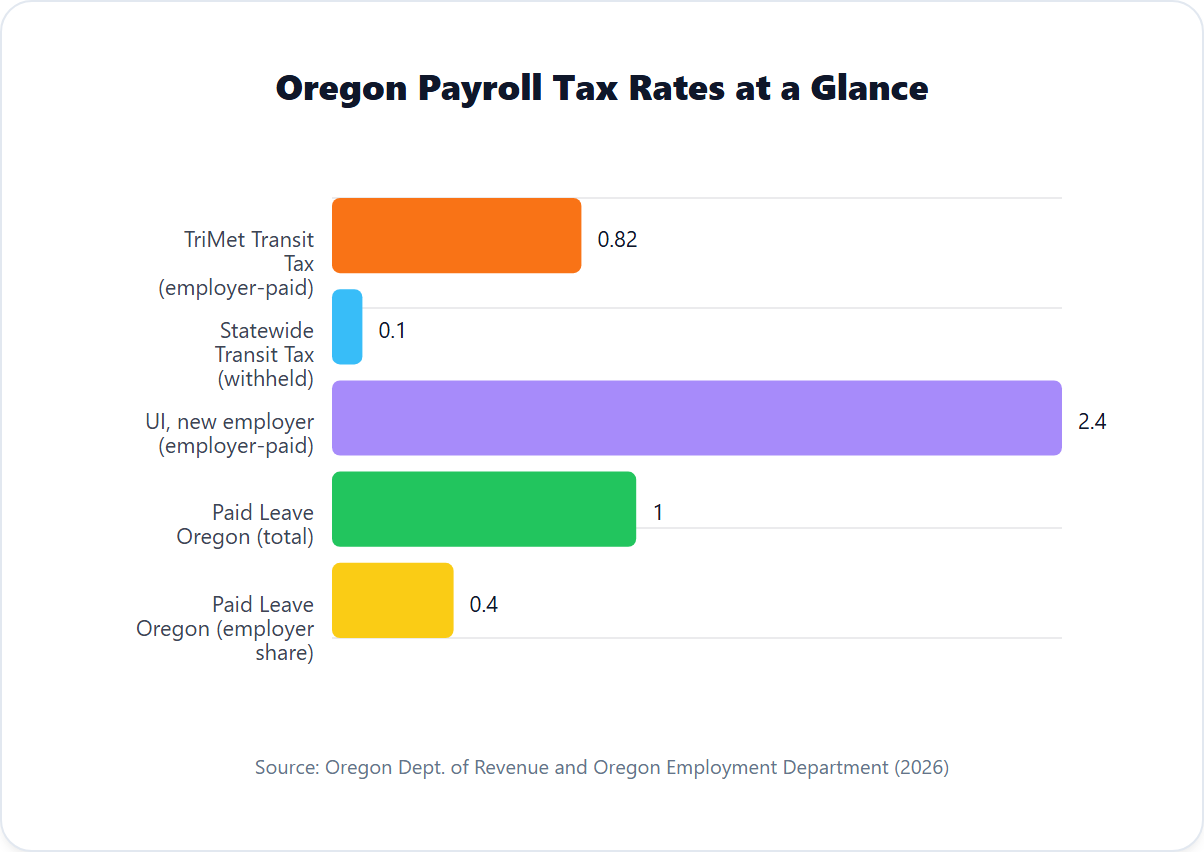
- The TriMet Transit Payroll Tax (0.8237% of gross wages) is paid by the employer directly – it is never withheld from an employee’s paycheck
- The Oregon Statewide Transit Tax (0.1% of wages) is the opposite: it’s withheld from employee pay, not paid by the employer
- Paid Leave Oregon’s employer share (0.4% of the 1% total) only applies to employers averaging 25 or more employees; smaller employers still withhold the employee’s 0.6% share
- Metro Supportive Housing Services and Multnomah Preschool for All withholding is mandatory only once an employee’s Metro/Multnomah wages hit $200,000 in a year – below that, withholding is voluntary at the employee’s election
In this article:
- Employer Pays vs. Employer Withholds
- Getting Registered Before Your First Paycheck
- Oregon State Income Tax Withholding
- Oregon Unemployment Insurance (UI) Tax
- TriMet Transit Tax vs. Oregon Statewide Transit Tax
- Paid Leave Oregon
- Workers’ Compensation and the WBF Assessment
- Do You Need to Withhold Metro SHS or Multnomah PFA?
- New-Hire Reporting
- Frequently Asked Questions
- Conclusion
Employer Pays vs. Employer Withholds
Before the details, the single distinction that resolves most confusion:
| You pay this out of pocket | You withhold this from employee pay |
|---|---|
| TriMet Transit Tax (0.8237%) | Oregon Statewide Transit Tax (0.1%) |
| Unemployment Insurance (0.9%-5.4%, new employer 2.4%) | Oregon state income tax (per OR-W-4) |
| Paid Leave Oregon employer share (0.4%, 25+ employees) | Paid Leave Oregon employee share (0.6%) |
| Half the WBF assessment (0.9 cents/hour) | Half the WBF assessment (0.9 cents/hour) |
Every section below states which column each tax belongs in before covering the rate.

Getting Registered Before Your First Paycheck
Oregon employers must register for a Business Identification Number (BIN) through Revenue Online or the Combined Employer’s Registration form before issuing a first paycheck (Oregon Department of Revenue). A federal EIN is a prerequisite. Online registration typically processes within about 14 business days; paper filings take roughly three weeks, so register early if you’re planning a specific start date.
Oregon State Income Tax Withholding
Oregon requires its own state-specific withholding, calculated from Form OR-W-4 rather than relying on the federal W-4 alone. The Oregon Department of Revenue publishes updated withholding tables and formulas each year and administers income tax withholding, unemployment insurance, the WBF assessment, and transit taxes together through the Combined Payroll Tax Report (Oregon DOR Withholding Tax Tables, effective 2026).
Oregon Unemployment Insurance (UI) Tax
Unemployment Insurance is an employer-paid tax with a rate that depends on your experience rating. New employers pay a flat 2.4% for 2026; experienced employers fall somewhere in a 0.9%-5.4% range under Tax Schedule 3. The taxable wage base per employee rises to $56,700 for 2026, up from $54,300 in 2025 – a 4.4% increase (Oregon Employment Department, Nov. 18, 2025).
Because UI is calculated on a per-employee wage base rather than total payroll, adding employees increases your total UI liability roughly linearly, not just your rate.
TriMet Transit Tax vs. Oregon Statewide Transit Tax
These two taxes have similar names and opposite mechanics, and mixing them up is the single most common payroll error for Portland-area employers.
The TriMet Transit Payroll Tax is 0.8237% of gross wages paid to employees working within the TriMet district, which covers Portland. It is imposed directly on the employer – never withheld from an employee’s paycheck – and administered by the Oregon Department of Revenue, not TriMet itself, through the same Combined Payroll Tax Report used for other state payroll taxes (Oregon DOR, A Guide to TriMet and Lane Transit Payroll Taxes, rev. Nov. 18, 2025). Employers outside the Portland area, such as those in Eugene or Springfield, instead fall under the separate Lane Transit District tax (0.80%), which does not apply to Portland employers.
The Oregon Statewide Transit Tax is 0.1% of wages – a completely separate tax that the employer withholds from employee pay and remits, rather than paying directly. It applies to wages of Oregon residents regardless of where they work, and to nonresidents working in Oregon. A 2026 ballot measure that would have raised this rate to 0.2% did not pass in the May 2026 primary, so the rate remains 0.1% for all of 2026 (Oregon DOR).
Paid Leave Oregon
Paid Leave Oregon’s total contribution rate is 1% of subject wages, capped at $184,500 per employee for 2026. The split depends on your headcount: employees always pay 60% of the contribution (0.6% of wages) through withholding, while employers averaging 25 or more employees pay the remaining 40% (0.4%). Employers averaging fewer than 25 employees are exempt from the employer share, but they must still withhold and remit the employee’s 60% (Oregon Employment Department 2026 rate notice; Paid Leave Oregon, Small Employers).
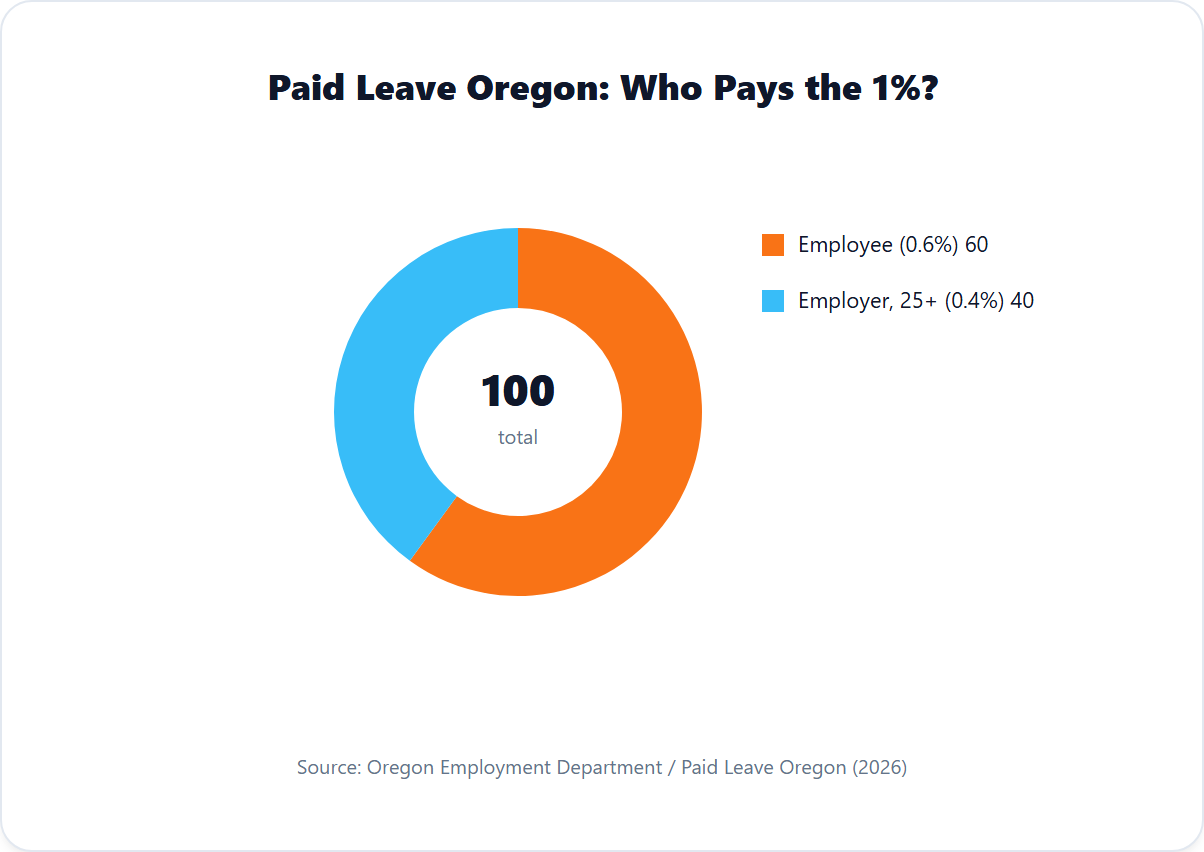
The 25-employee threshold is based on your average headcount over the prior four quarters, not a snapshot on any single day – a business hovering near 25 employees should track this average carefully rather than checking it once a year.
Workers’ Compensation and the WBF Assessment
These are two distinct obligations that are easy to conflate.
Workers’ compensation insurance is a coverage mandate: nearly every Oregon employer with at least one subject worker must carry a policy, whether through SAIF, a private carrier, or self-insurance. Certain corporate officers, partners, family-member owners, and independent contractors may be exempt. Non-compliance carries a real penalty – up to twice the premium owed or a $1,000 minimum, plus $250 per day for a continued violation (SAIF Employer Guide; Oregon DAS). There is no single statewide premium rate to quote here – premiums are set by individual insurers based on job class codes and your claims experience.
The Workers’ Benefit Fund (WBF) assessment is a separate, fixed cents-per-hour charge that funds workplace injury programs. For 2026, it’s 1.8 cents per hour worked – the lowest rate since the assessment began in 1996 – split evenly between employer and worker, 0.9 cents each (Oregon DCBS/Workers’ Compensation Division, effective Jan. 1, 2026).
Do You Need to Withhold Metro SHS or Multnomah PFA?
Our Portland business tax guide covered Metro Supportive Housing Services (SHS) and Multnomah Preschool for All (PFA) as personal income taxes an employee may owe on their own return. What that guide didn’t cover is the employer’s side: do you need to withhold either tax from paychecks?
The answer is threshold-triggered, not automatic. Withholding becomes mandatory only once a given employee’s Metro and/or Multnomah wages reach $200,000 in a calendar year. Below that threshold, withholding is voluntary – an employee can opt in using a Metro/Multnomah withholding election form, but you have no default duty to withhold. Once you do withhold for an employee at or above $200,000, you’ll also need to e-file W-2 data with the City of Portland Revenue Division, which collects both taxes on behalf of the county and the region (City of Portland Revenue Division, Withholding Information for Employers).
This is a common point of confusion: some employers assume they have no withholding duty at all, while others assume it applies to every employee. Neither is right – check each highly-compensated employee’s Metro/Multnomah wages against the $200,000 mark specifically.
New-Hire Reporting
Oregon employers must report all new hires and rehires to the Oregon DOJ Child Support Program within 20 days of hire, whether by mail, fax, or online (Oregon DOJ). Employers who report electronically through the Oregon Employer Services Portal generally submit on a shorter cycle, roughly every 12 to 16 days. Since 2023, this requirement also covers newly engaged or reengaged independent contractors, not just W-2 employees.
Frequently Asked Questions
Do I withhold TriMet tax from employee paychecks?
No. The TriMet Transit Payroll Tax is paid directly by the employer out of business funds – it is never deducted from an employee’s wages, unlike the similarly-named Statewide Transit Tax.
What’s the difference between TriMet tax and the Statewide Transit Tax?
TriMet tax (0.8237% of gross wages) is employer-paid and applies only within the TriMet district, which includes Portland. The Statewide Transit Tax (0.1% of wages) is withheld from employee pay and applies statewide, regardless of transit district.
Do I owe Paid Leave Oregon if I have 10 employees?
You owe the employee-share withholding regardless of size – that never changes. But with 10 employees, you’re below the 25-employee average threshold, so you’re exempt from the separate 0.4% employer share; only the employer share is size-dependent.
When do I need workers’ comp insurance in Oregon?
Nearly as soon as you have one subject worker. Most Oregon employers must carry workers’ compensation insurance from day one, with narrow exemptions for certain corporate officers, partners, family-member owners, and independent contractors.
Do I need to withhold Metro or Multnomah tax for all employees?
No. Withholding is mandatory only once an individual employee’s Metro and/or Multnomah wages reach $200,000 in a year. Below that, withholding is voluntary at the employee’s election, not a default employer obligation.
Conclusion
The fastest way to stay compliant on Portland payroll taxes is to sort every obligation into one of two buckets first: what you pay directly (TriMet tax, UI, your share of Paid Leave Oregon and the WBF assessment) and what you withhold from employees (state income tax, the Statewide Transit Tax, the employee share of Paid Leave Oregon and the WBF assessment, and Metro/Multnomah tax above $200,000). Register for your BIN before the first paycheck, and revisit the Paid Leave Oregon and Metro/Multnomah thresholds each time your headcount or a specific employee’s pay changes meaningfully.
If you’re setting up payroll for the first time, pairing this guide with our bookkeeping fundamentals will help you track these obligations accurately from your very first pay run.
Automate Your Portland & Oregon Payroll Compliance
Enter And Post LLC provides end-to-end payroll processing, quarterly combined tax reporting, and direct deposit starting at $7.50 per employee per payroll. We handle your Oregon BIN filings, TriMet transit reporting, Paid Leave Oregon calculations, and W-2/1099 compliance with zero hassle.
Explore Portland Payroll Services Schedule a Free Payroll Consultation