

Key Takeaways for Digital Sellers
- Automatic Copyright Protection: Copyright protects your original work the moment it is fixed in a tangible form. Registration is voluntary, but you must register a US work before filing an infringement lawsuit. Ideas, systems, and methods are not protected.
- Post-Wayfair Sales Tax Nexus: Since the Supreme Court’s South Dakota v. Wayfair decision, states can require remote digital sellers to collect sales tax once economic nexus thresholds are met. Taxability varies widely by state and product type under Streamlined Sales Tax (SST) rules.
- Self-Employment Income Tax: Digital product sales are reported on Schedule C (Form 1040). Net earnings of $400 or more require filing, triggering self-employment tax (Schedule SE) and quarterly estimated tax payments (Form 1040-ES).
- CAN-SPAM Marketing Compliance: Marketing emails must feature truthful headers, accurate subject lines, an ad disclosure, a valid physical postal address, and a functional unsubscribe mechanism honored within 10 business days (penalties up to $53,088 per violation).
- FTC Review & Endorsement Rules: The FTC strictly prohibits unsupported earnings claims and fabricated reviews. The FTC’s comprehensive rule against fake reviews and testimonials took effect on October 21, 2024.
Digital products look deceptively simple. You create a financial spreadsheet template, an ebook, a video workshop, or a design printable once, and customers download it on demand. There is no physical inventory to store, no supply chain bottleneck, and no shipping boxes. Yet, in the eyes of state departments of revenue, the IRS, the US Copyright Office, and the Federal Trade Commission, a digital download is a commercial transaction.
Failing to understand your legal and tax responsibilities early can result in retroactive sales tax liabilities, unexpected self-employment tax penalties, or intellectual property disputes. This guide outlines the essential legal and tax fundamentals every US digital product creator must understand before opening for business.
What Counts as a Digital Product?
A digital product is any intangible asset or educational deliverable that customers receive electronically rather than as physical freight. While operational overhead is lower than physical ecommerce, each format introduces distinct intellectual property and support liabilities:
| Digital Product Type | Real-World Examples | Creation Effort | Primary Risk & Legal Exposure |
|---|---|---|---|
| Templates & Printables | Spreadsheets, budgeting sheets, Notion workspaces, Canva layouts | Low to Medium | Unauthorized reselling, copying, and unclear commercial usage terms. |
| Ebooks & Action Guides | Comprehensive PDF playbooks, checklists, industry workbooks | Medium | Accuracy liability, third-party copyright claims, pirated redistribution. |
| Courses & Masterclasses | Asynchronous video modules, live workshop recordings, certifications | High | Student support workload, refund chargebacks, and earnings claims scrutiny. |
| Audio, Samples & Music | Audio tracks, DAW sample packs, sound effects, guided meditations | Medium to High | Master recording rights, sample clearance, and mechanical royalties. |
| Software, Scripts & Plugins | WordPress plugins, automation scripts, SaaS extensions, web apps | High | Security vulnerabilities, ongoing bug maintenance, API deprecation. |
| Memberships & Subscriptions | Recurring content vaults, private communities, premium templates | High | Recurring billing compliance, negative option disclosures, and churn. |
Choosing and Validating Your Product Concept
The most profitable digital products solve a sharp, repetitive operational problem that you already understand intimately. For example, a professional bookkeeper might produce an end-of-month financial reconciliation checklist; a licensed general contractor might sell an itemized project bidding model.
Before dedicating hundreds of hours to production, execute four validation steps:
1. Interview Target Buyers
Conduct 15-minute discovery calls with 5 to 10 prospective buyers. Ask what tools they currently use, what frustrates them, and what specific manual tasks cost them the most time.
2. Analyze the Competitive Landscape
Examine existing templates or guides. If alternatives are plentiful, your product must offer a distinct angle—such as state-specific compliance, higher design polish, or included automation scripts.
3. Pre-Test Demand with a Simple Landing Page
Build a single-page waitlist or pre-order landing page describing the product and collecting email signups. Real subscriber intent provides objective validation before you build.
4. Conduct a Commercial IP Audit
Verify that every component within your product—including stock photography, typography, vector assets, and code libraries—carries an explicit commercial license permitting redistribution.
Who Owns Your Work: Copyright & Licensing Fundamentals
According to the United States Copyright Office, an original creative work is automatically protected by copyright the exact moment it is created and fixed in a tangible medium of expression (e.g., typed into a document, written in code, or recorded to audio).
While formal registration with the US Copyright Office is voluntary, registration is a mandatory statutory prerequisite before you can file a copyright infringement lawsuit in federal court. Registering your work within three months of publication establishes a public record of ownership and unlocks the ability to seek statutory damages (up to $150,000 per willful infringement) and attorney’s fees under 17 U.S.C. § 412.
What Copyright Does NOT Protect
Under 17 U.S.C. § 102(b), copyright does not protect raw facts, abstract ideas, algorithms, mathematical formulas, systems, or methods of operation. It only protects your unique, original expression of those ideas. For example, your unique wording, layout, and visual formatting of a bookkeeping guide are protected, but a competitor is legally free to create their own original guide teaching the exact same double-entry accounting method.
Your Digital Product Licensing Checklist
When someone purchases a digital product, they are not buying the underlying copyright; they are purchasing a limited revocable license to use your intellectual property. A clear End User License Agreement (EULA) or Terms of Purchase prevents disputes:
- User Scope: Is the license granted for an individual single user, a single commercial entity, or an enterprise team?
- Modification Rights: Are buyers permitted to customize, edit, or white-label the template for their own internal operations?
- Distribution Restrictions: State clearly whether buyers are prohibited from reselling, sublicensing, or distributing the raw asset.
- Duration: Is access perpetual, or does it terminate upon cancellation of a recurring subscription?
- Breach Terms: What constitutes a material violation, and what remedies are reserved upon infringement?
Sales Tax on Digital Products Post-Wayfair
Sales tax is the compliance area most likely to catch digital sellers unprepared. Historically, businesses only collected sales tax in states where they maintained physical presence (offices, warehouses, or employees).
On June 21, 2018, the US Supreme Court issued its landmark ruling in South Dakota v. Wayfair, Inc. (17-494), overturning the physical presence standard as “unsound and incorrect.” The Court held that states can mandate sales tax collection from out-of-state remote sellers who establish an economic nexus. In South Dakota, the benchmark was $100,000 in gross annual sales or 200 separate transactions. Today, more than 45 states have adopted economic nexus rules with distinct revenue and transaction thresholds.
Streamlined Sales Tax (SST) & Product Categorization
Under the Streamlined Sales Tax (SST) Agreement, each state retains the sovereignty to determine which digital subcategories are taxable and which are exempt (SST Interpretative Rule 332.1):
- Digital Audio Works: Streamed or downloaded songs, music tracks, ringtones, and podcasts.
- Digital Audio-Visual Works: Video tutorials, streamed webinars, recorded courses, and films.
- Digital Books: Ebooks, digital whitepapers, and PDF reading materials.
*Important: An ebook might be exempt from sales tax in one state, while a software plugin or digital audio track is taxable in that same state. Oregon, notably, has no general state sales tax, but selling to buyers in Washington, California, or New York subjects you to their specific state nexus statutes.
5-Step Sales Tax Compliance Action Plan
- Track Customer Geography: Record the billing state and zip code for every digital sale in your payment processor.
- Monitor State Nexus Thresholds: Track cumulative trailing 12-month sales volume per state against statutory thresholds (typically $100,000 or 200 sales).
- Classify Your Digital Taxonomy: Match each product SKU against state taxability matrices (e.g., whether your state taxes automated SaaS vs. static digital downloads).
- Deploy Automated Tax Tools: Implement an automated tax engine (such as Stripe Tax, TaxJar, or Avalara) to calculate, collect, and report destination-based sales taxes in real time.
- Register Before Collecting: Never collect sales tax from customers in a state where your business is not formally registered with the Department of Revenue; doing so is illegal in most jurisdictions.
Income Tax & Bookkeeping for Digital Creators
If you sell digital products as a sole proprietor or single-member LLC without a corporate tax election, the IRS treats you as self-employed. According to the IRS Self-Employed Individuals Tax Center, several vital tax requirements apply:
Schedule C (Form 1040)
Report total digital gross receipts and deduct allowable ordinary and necessary business expenses (hosting, software subscriptions, merchant fees, design tools).
Schedule SE (Self-Employment)
Calculates 15.3% self-employment tax (12.4% Social Security + 2.9% Medicare). Filing is mandatory if your net self-employment earnings reach $400 or more.
Form 1040-ES Quarterly Taxes
Because digital payments have no automated W-2 tax withholding, you must remit quarterly estimated income and self-employment taxes (due in April, June, September, and January).
Form 1099 Information Returns
Payment processors issue Form 1099-K. Likewise, if you pay contractors $600 or more annually (e.g., freelance designers or voice actors), you must file Form 1099-NEC.
Keep Your Digital Books Pristine
Enter and Post LLC provides dedicated monthly bookkeeping for $99/mo and corporate tax filings for $300. We reconcile every payment gateway, calculate merchant fees, and ensure Schedule C audit compliance.
Where to Sell: Your Own Website vs. Marketplace Platforms
Deciding whether to host checkout on your own WordPress/WooCommerce site or leverage third-party marketplaces (Etsy, Gumroad, AppSumo, Teachable) involves evaluating trade-offs across margins, governance, and audience control:
| Evaluation Factor | Your Own Website (Direct) | Marketplace / Hosted Platform |
|---|---|---|
| Branding & Funnel Control | 100% full control over user experience, custom styling, upsells, and branding. | Restricted to vendor templates; competitors often displayed alongside your product. |
| Customer Data & Email List | You own 100% of the customer records, email addresses, and lifetime value data. | Often masked, limited, or subject to restrictive marketplace communication policies. |
| Transaction & Platform Fees | Standard merchant fees (~2.9% + 30¢ via Stripe/PayPal); zero marketplace cuts. | Platform take-rates range from 5% to 50% plus payment processing fees. |
| Sales Tax Administration | You configure automated tax calculation (Stripe Tax) and remit where nexus exists. | Many act as Marketplace Facilitators, handling collection and remittance automatically. |
| Account Continuity Risk | Self-hosted stability; you cannot be unilaterally deplatformed or suspended. | Vulnerable to automated algorithm flags, policy revisions, and account freezes. |
The 6-Step Digital Product Launch Framework
Launching a digital product requires an orderly progression to prevent compliance and refund liabilities before opening sales:
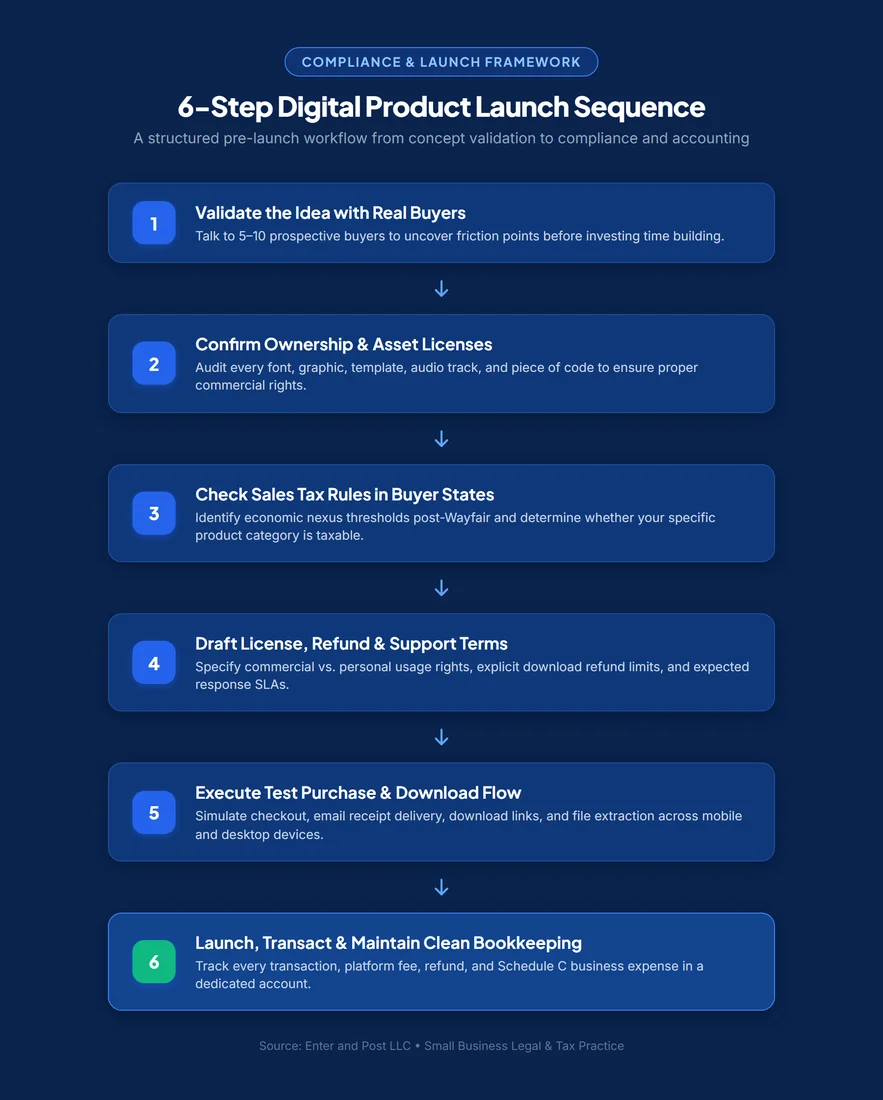
Figure 1: Standardized sequential pre-launch compliance framework for digital creators.
Marketing Compliance: CAN-SPAM Act & FTC Consumer Rules
Driving sales through email outreach and marketing campaigns requires strict adherence to federal trade regulations:
1. CAN-SPAM Act Requirements
Under the Federal Trade Commission’s CAN-SPAM Act enforcement guidelines, every commercial email message must satisfy five non-negotiable rules:
- Truthful Header Information: The “From,” “To,” and routing domain headers must accurately identify your legal business identity.
- Accurate Subject Lines: Subject lines cannot be deceptive or artificially unrelated to the message content.
- Clear Advertisement Disclosure: Commercial emails must clearly disclose that the message is an advertisement.
- Valid Physical Postal Address: A current physical postal address must be included in every marketing email (a registered P.O. Box or commercial mail receiving agency meets this requirement).
- Working Opt-Out Mechanism: You must provide a one-click unsubscribe mechanism that is honored within 10 business days. Statutory penalties reach up to $53,088 per violating email.
2. FTC Endorsements & New Fake Reviews Rule
How you present your digital product creates legal exposure beyond mere customer dissatisfaction:
- No Unsupported Earnings Claims: If you sell educational material or business software, you cannot claim or imply typical income benchmarks (e.g., “$10,000/month in passive income”) without documented substantiation across typical users.
- October 21, 2024 Fake Reviews Rule: The FTC’s Trade Regulation Rule on Consumer Reviews and Testimonials bans fake or incentivized consumer reviews, celebrity endorsements without personal use, and review suppression. Testimonials must reflect authentic, verifiable purchaser experiences.
- Transparent Visuals: Product landing pages must showcase real screenshots, sample file previews, page counts, and exact software compatibility requirements so buyers understand what they receive.
Frequently Asked Questions (FAQ)
Do I need to register my product with the US Copyright Office before launching?
No. Copyright protection attaches automatically once your creative work is fixed in a tangible format. Registration is entirely voluntary; however, you must have an active copyright registration on file before you can initiate an infringement lawsuit in federal court. Registering early also preserves your eligibility for statutory damages up to $150,000 and legal fee recovery.
Must I collect sales tax if I live in a state with no sales tax like Oregon?
Yes, potentially. Following the Supreme Court’s South Dakota v. Wayfair decision, sales tax liability is determined by the buyer’s location, not the seller’s. If your digital product sales exceed an out-of-state economic nexus threshold (commonly $100,000 in sales or 200 transactions), that destination state requires you to register, collect, and remit their specific sales taxes.
Should I form an LLC before selling digital products?
While you can legally operate as a sole proprietorship from day one, forming a Limited Liability Company (LLC) establishes a legal shield that separates your personal assets (home, personal savings) from business liabilities. If your digital product involves professional advice, contracts, or software with liability exposure, forming an LLC is highly recommended.
Can I email customers who purchase my digital products?
You can send transactional emails (receipts, download credentials, critical product updates) without prior consent. However, to send commercial promotional emails or newsletters, you must provide a prominent opt-in, clear unsubscribe functionality, and include your physical business address in full compliance with the CAN-SPAM Act.
What is the IRS threshold for reporting self-employment income from digital sales?
You must file an income tax return and pay self-employment tax if your net self-employment earnings reach $400 or more during the tax year. Digital sales are reported on IRS Schedule C, with self-employment tax computed on Schedule SE.
Your Pre-Launch Compliance Checklist
Ensure these eight operational checkpoints are verified before opening your digital store:
Define exact problem solved and target buyer profile.
Audit commercial license rights for every asset and font.
Draft explicit End User License and clear refund terms.
Review sales tax rules for your top three buyer states.
Establish a dedicated commercial bank account for transactions.
Perform end-to-end test checkout and download on mobile and desktop.
Include postal address and unsubscribe links in marketing templates.
Verify all sales copy complies with FTC testimonial standards.
Talk to Our CPA & Bookkeeping Team