
If you run a business in Portland, you’ve probably had an email promising “page one of Google” for a monthly fee. Before you pay anyone, it helps to know what search engine optimization (SEO) actually involves, what you can do yourself, and which promises should make you walk away.
This guide covers the fundamentals for a small, locally focused Pacific Northwest business—from Google Business Profile optimization to on-site technical structure to authentic customer reviews. It relies on Google’s official documentation and the Federal Trade Commission (FTC), not speculative rankings claims, so you can verify each point. It is general educational information and not legal advice.
Key Takeaways
- Google ranks local businesses primarily on Relevance, Distance, and Prominence: Google explicitly states that there is no way to request or pay for a better local map ranking.
- Start with a complete, honest Google Business Profile: Google’s guidelines on business names, street addresses, and service areas are strict, and violations risk immediate suspension.
- On-site SEO fundamentals cost nothing but attention: Unique page titles, clear headings, descriptive link anchor text, and meaningful image alt text remain the highest-impact elements.
- Never buy reviews or offer incentives for positive feedback: The FTC’s comprehensive Rule on Consumer Reviews took effect on October 21, 2024, imposing severe civil penalties on businesses and agencies buying or faking reviews.
- Local SEO results take time: Google Search Central advises waiting several weeks before judging whether an optimization had an effect. Treat guaranteed ranking dates with suspicion.
In this article:
- • What is SEO, and how long does it take?
- • How local search works in Portland
- • Step 1: Claim and set up your Google Business Profile
- • Step 2: Make your website easy to find and understand
- • Step 3: Choose the words your customers use
- • Step 4: Earn reviews the right way (FTC Compliance)
- • Step 5: Publish useful pages and earn local links
- • How to measure progress effectively
- • Hiring help: questions and red flags
- • Frequently asked questions
- • What to do this week (6-Step Checklist)
What is SEO, and how long does it take?
Search engine optimization (SEO) is the ongoing work of making your business easier for search engines to discover, understand, index, and present to people seeking your services. For a Portland neighborhood shop, dental clinic, specialty contractor, or accountant, that means appearing when someone nearby searches for what you offer.
Nobody can responsibly promise an exact ranking date. Google’s official SEO Starter Guide notes that search updates can take anywhere from a few hours to several months to reflect in live results, and Google recommends waiting at least a few weeks before evaluating whether a change made an impact (Google Search Central, SEO Starter Guide). Treat any marketing provider who guarantees a specific ranking by a specific calendar date with extreme skepticism.
How local search works in Portland
When a customer searches for “plumber near me” or “bakery in Southeast Portland,” Google generates a localized Map Pack and organic local listings chosen differently from standard web pages. Google explains that local results are “mainly based on relevance, distance, and prominence” (Google Business Profile Help):
- Relevance: How well your business profile matches what the person searched for. Complete, detailed service descriptions and correct category selections directly feed this factor.
- Distance: How far your business address or verified service area is from the searcher or the neighborhood they specified.
- Prominence: How well-known your business is. Google measures prominence through real-world reputation, local articles, directory citations, quality website backlinks, and review volume and ratings.
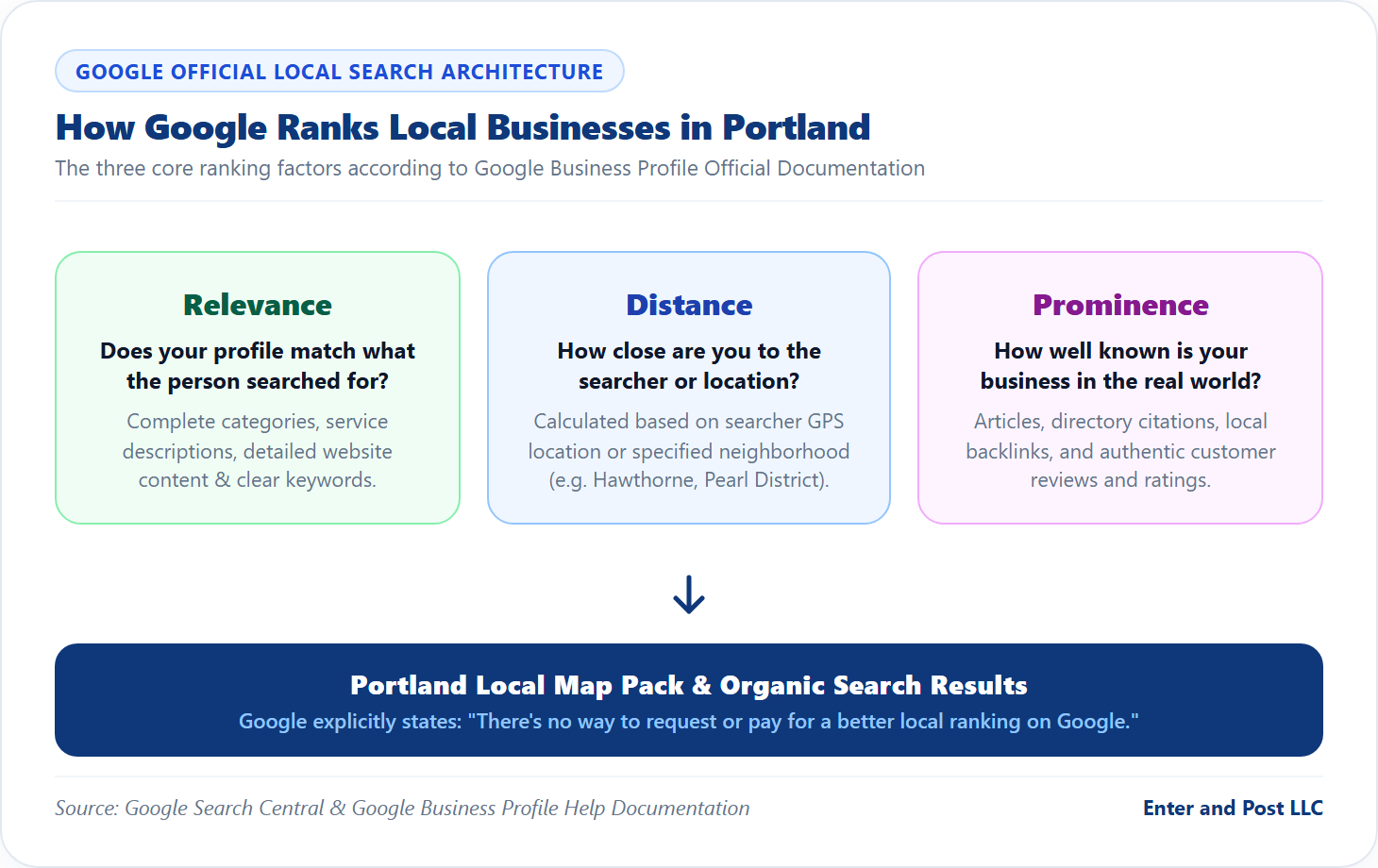
Google states plainly in its documentation: “There’s no way to request or pay for a better local ranking on Google.” That single sentence disqualifies any pitch that promises paid organic positioning. While you cannot change your physical location, you can significantly improve your relevance and prominence.
Step 1: Claim and set up your Google Business Profile
Your Google Business Profile (GBP) is the listing that appears across Google Search and Google Maps. For brick-and-mortar and local service businesses, it is the single most valuable free digital asset you own. Follow Google’s guidelines strictly, because policy violations can cause profile suspension (Google Business Profile Guidelines):
- Eligibility: You must have a physical location that customers can visit during stated hours, or operate as a service-area business (SAB) that travels directly to customers. Service-area businesses (such as mobile detailers, roofers, or plumbers) must hide their residential address from public view.
- Business Name: Use your real-world legal or DBA business name exactly as it appears on your signage, tax filings, and branding. Adding extra keywords, cities, or taglines (such as “Joe’s Plumbing | Best Plumber Portland OR”) is considered keyword stuffing and frequently triggers instant algorithmic suspension.
- Address: Provide an accurate physical address. P.O. boxes and remote mailboxes (like UPS Store boxes) are strictly ineligible. Virtual offices and co-working spaces qualify only if you rent dedicated private space with permanent signage, receive clients during normal business hours, and have your own staff on site.
- Complete Profile Information: Select your primary category accurately, specify your opening hours, upload genuine photos of your team and work, and keep holiday hours updated.

Step 2: Make your website easy to find and understand
Your website anchors your digital presence and validates the information on your Google Business Profile. Google’s Search Essentials list core technical and content fundamentals that cost nothing but attention:
| Task | What Google says | What to do |
|---|---|---|
| Be findable | Google discovers pages through links from pages it already knows | Link between your own pages; earn citations from local directories and partners |
| Check indexing | Use the site: operator to see whether pages appear |
Search site:yourdomain.com on Google to identify missing pages |
| Write unique titles | Titles should be unique, clear, concise and accurate | Craft one distinctive title tag per page describing its specific service |
| Write meta descriptions | Short, unique summaries covering key points | Write custom 150-character meta descriptions; never copy-paste one across pages |
| Use descriptive link text | Link anchor text informs users and search crawlers about destination content | Use “our kitchen remodeling services” instead of vague “click here” |
| Describe images | High-quality images near relevant text with descriptive alt attributes | Add concise alt text such as “Crew installing a new roof on a Portland bungalow” |
| Ensure crawlability | Googlebot needs full access to CSS, JavaScript, and images | Test key landing pages with the URL Inspection Tool in Google Search Console |
Two practical tips: Google often generates search snippets from body text rather than meta descriptions if the page text is clearer. Second, always add rel="nofollow" to untrusted external links or user-generated comments. If you are planning a site redesign, our guide to hiring a web developer in Portland explains how to evaluate technical SEO capabilities before contracting an agency.
Step 3: Choose the words your customers use
Effective local SEO reflects the natural language real customers speak and type. Rather than paying for inflated third-party keyword tools, you can discover genuine local intent for free:
- Google Search Console Performance Reports: Once your site is verified, review the Queries tab. You will often discover high-impression search terms you never intentionally targeted.
- Google Autocomplete: Type your core service into Google and observe suggested completions.
- Your Own Customers: Listen to the exact words callers use when asking about your services. Everyday client phrases consistently outperform internal industry jargon.
- Portland Neighborhood & Regional Terms: People search by location. If you serve customers in the Pearl District, Hawthorne, Alberta Arts, St. Johns, or Beaverton, naturally mention those areas in your case studies and service pages.
Always write for human readers first. Repetitive, robotic keyword stuffing violates Google’s Search Essentials and degrades user conversion rates.
Step 4: Earn reviews the right way (FTC Compliance)
Customer reviews enhance prominence on Google Maps and heavily influence consumer trust. You can actively invite happy clients to review your business via email, SMS, or cards at checkout. Providing a direct short-link makes the process effortless.
⚠️ FTC Rule on Consumer Reviews (Effective October 21, 2024)
The Federal Trade Commission’s final rule on fake reviews and testimonials (16 CFR Part 465) establishes substantial civil penalties (up to $51,744 per violation) against businesses and agencies that:
- Create, purchase, or disseminate fake or AI-generated reviews.
- Provide incentives, discounts, or compensation conditioned on positive sentiment.
- Publish employee or insider reviews without clear, prominent disclosure.
- Use baseless legal threats or intimidation to suppress negative consumer feedback.
If an SEO provider pitches “reputation packages” or promises to “deliver 50 five-star reviews,” ask for their exact methodology in writing. Engaging in prohibited review practices creates severe legal exposure. When you receive a negative review, respond calmly, professionally, and factually—future customers judge your character by how you handle criticism.
Step 5: Publish useful pages and earn local links
Over time, helpful, authoritative content earns organic backlinks and steady customer engagement. For a Portland small business, your content architecture should focus on:
- Dedicated Service Pages: Create distinct pages for each major service offering, explaining your process, who it suits, and your service boundaries.
- Plain-Text Location Details: Include your local address, operating hours, and neighborhood coverage in crawlable HTML text in your footer and contact pages.
- Educational Answers to Common Questions: Address real client concerns regarding pricing factors, preparation steps, and project timelines based on your hands-on field experience.
- Authentic Community Backlinks: Partner with local suppliers, sponsor neighborhood sports leagues, join the Portland Business Alliance, or speak at local trade associations.
Avoid dangerous black-hat shortcuts: Google’s spam policies strictly penalize scaled content abuse (programmatically churning out hundreds of identical neighborhood pages with only the city name swapped), link exchange rings, and doorway pages (Google Search Spam Policies).
How to measure progress effectively
Tracking your search performance should be simple and structured rather than an obsessive daily chore:
- Verify Google Search Console: Monitor your impressions, total clicks, and average ranking positions across specific customer queries.
- Review Business Profile Performance Insights: Track monthly profile views, direction requests on Google Maps, and incoming phone calls.
- Measure Real Business Conversions: Website traffic and keyword rankings matter only if they convert into phone calls, consultation forms, and paying customers.
- Allow Sufficient Evaluation Windows: Give technical or content updates several weeks to settle before altering strategy.
Hiring help: questions and red flags
If you choose to partner with an SEO freelancer or agency, use this diagnostic scorecard to separate legitimate technical partners from predatory marketers:
| Ask | A good answer | A warning sign |
|---|---|---|
| What will you actually do each month? | A transparent, itemized scope of technical fixes, content, and reports | Vague hand-waving about “proprietary algorithms” |
| Who owns my accounts? | You retain 100% primary ownership of your Google Business Profile, analytics, and Search Console | They register assets under agency-owned master accounts |
| How do you acquire backlinks? | Genuine local outreach, community PR, and high-value resource guides | Purchased private blog network (PBN) links or directory blast packages |
| How do you collect reviews? | Direct customer follow-up workflows and post-service messaging | Offering to supply or fabricate reviews (violating FTC rules) |
| What results can I expect? | Realistic ranges with acknowledgment that search algorithms fluctuate | Guaranteed #1 rankings or rigid timeline promises |
| How will you report progress? | Direct Search Console impressions, verified click trends, and lead tracking | Single vanity keyword ranking screenshots |
Frequently asked questions
Can I pay Google for a better local ranking?
No. Google explicitly confirms there is no mechanism to purchase higher organic or map rankings. Sponsored Google Ads and Local Services Ads are distinct commercial placements completely separate from organic search algorithms.
Do I need a physical storefront to have a Google Business Profile?
Not necessarily. Businesses that visit or deliver to customers qualify as Service Area Businesses (SABs). However, SABs must hide their residential address from public view. Virtual office mail drops and P.O. boxes do not qualify.
How long does it take to see local SEO results in Portland?
Timing ranges from several weeks to several months depending on your local competition, domain authority, and how quickly Google crawls and indexes your updates. Sustainable prominence builds steadily over 3 to 6 months.
Is it okay to ask customers for reviews?
Yes. Actively inviting legitimate clients to share honest feedback is completely permissible and encouraged. However, incentivizing positive reviews, conditioning rewards on sentiment, or buying reviews is strictly illegal under the FTC’s October 2024 review rules.
Should I handle SEO myself or hire an agency?
Foundational steps—claiming your Google Business Profile, writing descriptive title tags, adding image alt text, and requesting reviews—are entirely manageable in-house. Consider professional assistance for technical schema implementation, high-speed website engineering, or comprehensive content expansion.
What to do this week (6-Step Checklist)
Improve your local visibility starting today by executing these six concrete steps:
- Search your exact business name on Google: Review how your knowledge panel, phone number, and location appear in Search and Maps.
- Claim and verify your Google Business Profile: Ensure your legal name and physical address match official Oregon business registry records.
- Audit page title tags and image alt text: Ensure every core page has a unique, descriptive title tag and accurate image descriptions.
- Verify your domain in Google Search Console: Inspect indexation status and review real search queries driving traffic.
- Send review invitations to three recent happy clients: Share your direct Google review short-link without incentivizing sentiment.
- Schedule a performance review four weeks out: Allow search crawlers adequate time to process updates before judging impact.