Call Us Today! 503-895-5745

Custom Software Design in 2026: Why Security, Compliance, and Business Risk Now Shape Every Serious Project
SOFTWARE
5/7/20269 min read
Why software design is now a business risk decision
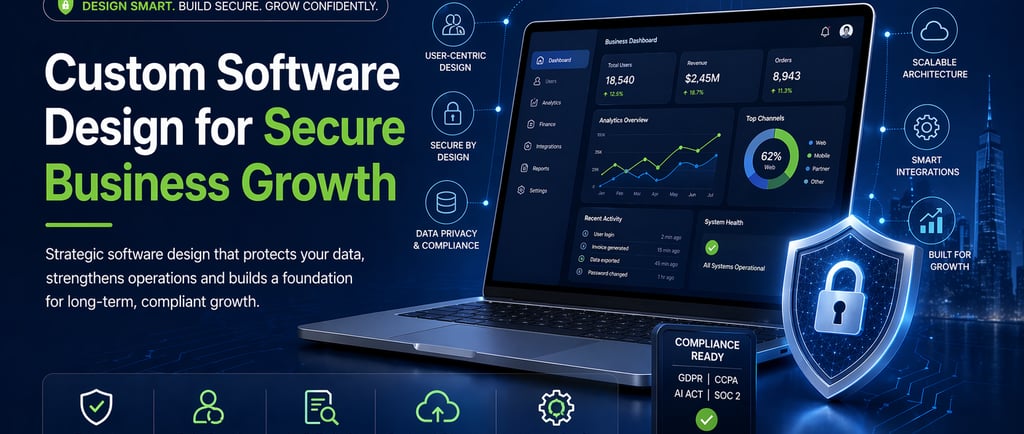
Custom software design is no longer only about making an application look clean or function smoothly. In 2026, businesses in the USA and global markets need software that is secure, compliant, scalable, and built around real operational risk. A poor design decision can create more than a bad user experience. It can expose customer data, weaken financial controls, create compliance gaps, slow internal teams, and increase the cost of future development.
The software world has changed because businesses now depend on connected systems. A customer portal may connect with payment tools, accounting platforms, CRM software, document storage, email automation, and AI features. That means design decisions now affect security, privacy, workflow speed, reporting quality, and business continuity.
This is why companies should not treat design as a visual step only. The real value of software design comes from planning how users, data, processes, integrations, permissions, and future upgrades will work together. When that foundation is weak, even a beautiful application can become expensive to maintain and risky to operate.
For companies like Enter and Post LLC, this creates a strong opportunity to position software design as a practical business protection service, not just a creative or technical service.
The compliance reason businesses are rethinking software
One of the biggest reasons software design has changed is regulation. Businesses now operate in an environment where privacy, cybersecurity, AI governance, and data handling rules are becoming stricter.
The EU AI Act entered into force on August 1, 2024. Prohibited AI practices have been banned since February 2, 2025, and high-risk AI requirements become mandatory on August 2, 2026. Non-compliance can carry fines up to €35 million or 7% of global revenue, depending on the violation.
Even if a company is based in the United States, global digital operations can still create exposure. A U.S. company selling services to customers in Europe, collecting user data from international clients, using AI-powered workflows, or offering software globally may need to consider privacy and AI-related obligations beyond its home market.
This is where software design becomes strategic. Compliance is easier when it is built into the system early. It becomes more expensive when companies try to add it after launch.
A business application should be designed with clear user permissions, data access limits, audit trails, secure authentication, consent handling, backup planning, and role-based workflows. These are not just technical details. They help protect the business from avoidable risk.
Why AI makes software design more sensitive
AI is now becoming part of everyday business software. Companies want AI chat support, automated document review, smart reporting, workflow suggestions, lead scoring, fraud alerts, and predictive analytics. But AI also changes the risk profile of an application.
IBM’s 2025 Cost of a Data Breach research found that 63% of breached organizations studied lacked AI governance policies, while only 37% had approval processes or oversight mechanisms in place.
That is a major warning for businesses adopting AI quickly. If AI features are added without proper design controls, companies may lose visibility over how data is being used, who can access it, what outputs are generated, and whether sensitive information is exposed.
Good custom software design should answer these questions before development begins:
● What data will the AI feature access?
● Who is allowed to use it?
● Should outputs be reviewed before action?
● Is customer or employee data involved?
● Can the system track activity for audits?
● Is there a way to disable or limit AI features if needed?
These questions matter because AI is not just another feature. It can influence decisions, process sensitive data, and create compliance responsibilities. For business software, AI must be designed with control, not just convenience.
Security-by-design is no longer optional
Cybersecurity is now one of the strongest reasons companies invest in better software planning. The old approach was to build the application first and test security later. That approach no longer works well because modern applications are too connected, data-heavy, and exposed to fast-changing threats.
A 2025 data breach report summary noted that a DevSecOps approach to software development was the number one factor that reduced breach costs, with AI and machine-learning insights and SIEM platforms also listed among the top cost-reducing factors. The same report stated that 97% of AI-related security breaches involved AI systems that lacked proper access controls.
This shows why design must include security from the beginning. A business application should not wait until final testing to think about access control, user roles, secure coding, data protection, and monitoring.
Security-by-design means the application is planned around protection from the start. It includes secure login systems, multi-factor authentication where needed, limited user permissions, encrypted data handling, secure APIs, activity logs, backup recovery, and clear admin controls.
For Enter and Post LLC, this is an important trust-building point. Many businesses do not need complicated technical explanations. They need a partner that can explain how the system will protect business data, reduce manual risk, and support long-term reliability.
Why user experience still matters, but differently
User experience is still important, but in 2026 it is not only about making software easy to use. It is also about reducing mistakes.
A confusing dashboard can cause employees to enter the wrong data. A weak approval process can allow unauthorized actions. A poorly designed customer portal can increase support requests. A bad reporting screen can lead managers to make decisions based on incomplete information.
This is why custom software design should focus on business behavior. The designer must understand how people actually work inside the company.
For example, an accounting team may need fast access to invoices, payment status, client documents, and approval history. A manager may need a high-level dashboard with alerts and exceptions. A customer may only need to upload files, check status, and receive updates. If all users see the same cluttered interface, the software becomes harder to use and easier to misuse.
A good design separates user roles clearly. It gives each person the right tools, the right data, and the right level of access. This improves productivity and also supports security.
Why generic software often fails operationally
Many companies start with off-the-shelf tools because they are fast to set up. That can work for basic needs. But as the business grows, generic software often creates limitations.
A company may end up using one tool for customer records, another for invoices, another for employee tasks, another for document storage, and another for reporting. Over time, employees begin copying data between systems manually. That creates errors, delays, and duplicate work.
Custom systems solve this by matching the company’s real workflow. The design can connect departments, automate repetitive steps, and reduce dependency on scattered spreadsheets.
This is especially useful for accounting, bookkeeping, HR, payroll, logistics, healthcare, service businesses, and companies with repeatable internal processes.
For example, a business may need a client portal where customers upload documents, the accounting team reviews them, managers approve work, and reports are generated automatically. A generic tool may handle part of this process, but a custom system can bring the full workflow into one controlled environment.
That is where Enter and Post LLC can stand out by connecting software design with real business operations, not just application screens.
The cost of weak design appears later
Poor design often looks cheaper in the beginning. A business may skip planning, reduce testing, avoid documentation, or build features quickly without thinking about future needs. But the cost usually appears later.
Weak design can create:
● expensive rebuilds
● slow performance
● security gaps
● poor user adoption
● broken integrations
● duplicate manual work
● compliance problems
● confusing reporting
● limited scalability
The real problem is that these issues often appear after the business has already invested money, trained staff, and started using the system. Fixing a live system is usually harder than designing it correctly from the start.
That is why companies should view design as risk prevention. Better planning may take more effort upfront, but it can reduce long-term costs and operational disruption.
What a secure design process should include
A practical software design process should begin with discovery. This means understanding the company’s workflow, users, data, risks, integrations, and business goals. Without this step, the project may solve the wrong problem.
After discovery, the team should map user roles. This includes admins, employees, managers, customers, vendors, finance teams, or any other user group. Each role should have clear permissions and responsibilities.
Then comes workflow design. This step defines how information moves through the system. For example, who submits a request, who approves it, who receives notifications, what happens after approval, and where the record is stored.
Next is data design. This includes what information is collected, where it is stored, how long it is kept, and who can access it. For regulated or sensitive industries, this step is extremely important.
Then comes interface design. The screen layout should support the real task, not just look modern. A good interface reduces clicks, prevents confusion, and makes important actions clear.
Finally, testing and review should happen before full development or launch. The business should review whether the design matches real work before the system becomes expensive to change.
Why compliance-friendly software helps global companies
A company targeting both USA and global customers needs to think beyond one market. Privacy and data rules differ by region. AI-related compliance is also developing quickly. Cybersecurity expectations are rising across industries.
The EU entered a major digital-policy year in 2026, with significant developments expected around data protection, AI governance, cybersecurity regulation, cyber-resilience obligations, and privacy transparency.
This does not mean every small business needs an enterprise-level legal system. But it does mean business software should be designed with flexibility. If the company grows into new markets, adds AI features, hires remote teams, or collects more sensitive data, the software should not collapse under new requirements.
Compliance-friendly design includes clear data structures, permission management, logs, documentation, consent handling, and the ability to update policies or workflows without rebuilding the entire system.
Why design documentation matters
Many businesses overlook documentation because they want to move quickly. But documentation is one of the most practical ways to protect a software investment.
Good documentation explains what the system does, how users interact with it, what data is collected, what integrations exist, and how different roles are managed. It also helps future developers maintain or improve the system.
Without documentation, a company becomes dependent on memory, assumptions, or one developer’s knowledge. This creates risk if the original developer leaves, the vendor changes, or the system needs major updates later.
For business software, documentation should not be treated as extra work. It is part of the product’s long-term value.
How businesses should choose a design partner
Choosing a software design partner should not be based only on portfolio appearance. A beautiful portfolio does not always mean the company understands business operations, compliance, security, or scalability.
A strong design partner should ask about business goals, user roles, data sensitivity, integrations, reporting needs, internal approval flows, and future growth. They should also be willing to challenge unnecessary features.
If a provider immediately agrees to every feature without asking why it matters, that can be a warning sign. Good software partners help businesses prioritize. They know that a smaller, focused version one is often more useful than a large, confusing system that takes too long to launch.
Businesses should look for a partner that can explain design choices in simple business terms. The conversation should not be only about screens, colors, or technology stacks. It should also cover risk, efficiency, security, and long-term maintenance.
Where Enter and Post LLC fits in
The strongest opportunity for Enter and Post LLC is to position software design as part of business improvement. Many companies do not only need an app. They need a smarter way to manage customers, documents, accounting tasks, employee workflows, reporting, and operational communication.
A custom application can help reduce manual effort, improve accuracy, protect sensitive data, and give managers better visibility. But the success of that application depends on how well it is designed before development begins.
This is why businesses should work with a team that understands both software and practical business processes. When design is connected to real operations, the final product becomes easier to use, easier to manage, and more valuable over time.
The future of custom software design
The future of software design will be shaped by AI governance, secure-by-design development, cloud-native systems, automation, privacy expectations, and business-specific workflows. Companies will not be satisfied with generic systems that only perform basic tasks. They will want software that supports growth, protects data, and adapts to changing business needs.
For USA and global companies, the main question is no longer “Can this software be built?” The better question is “Can this software be trusted, scaled, maintained, and used safely?”
That is the difference between basic development and strategic software design.
Conclusion
Custom software design in 2026 is about much more than appearance. It is about building business systems that are secure, compliant, practical, and ready for growth. A well-designed application can improve workflow speed, reduce manual errors, protect sensitive information, support AI features responsibly, and make daily operations easier for teams and customers.
Businesses that rush the design stage may save time at the beginning but face higher costs later. Businesses that invest in strong planning, clear user roles, security controls, compliance awareness, and scalable workflows are more likely to build software that creates long-term value.
If your business needs a secure custom application, client portal, internal dashboard, workflow automation system, or practical digital solution, Enter and Post LLC can help you plan and design software around real business needs.
CTA
Ready to design software that supports growth and protects your business? Contact Enter and Post LLC today to discuss your custom software project and build a solution made for real operations, real users, and real results.
Contact Us
Socials
📞 USA: (+1) 503-895-5745
📞 Pakistan: (+92) 332-3480678
🏢 Head Office:
Portland, Oregon, United States of America.
🏢 Back Office:
Karachi, Sindh, Pakistan.
© Copyright 2026 | Developed By | Enter and Post LLC