Call Us Today! 503-895-5745

Custom Software Services for Business Operations: How Companies Use Software to Fix Real Workflow Problems
SOFTWARE
5/11/20267 min read
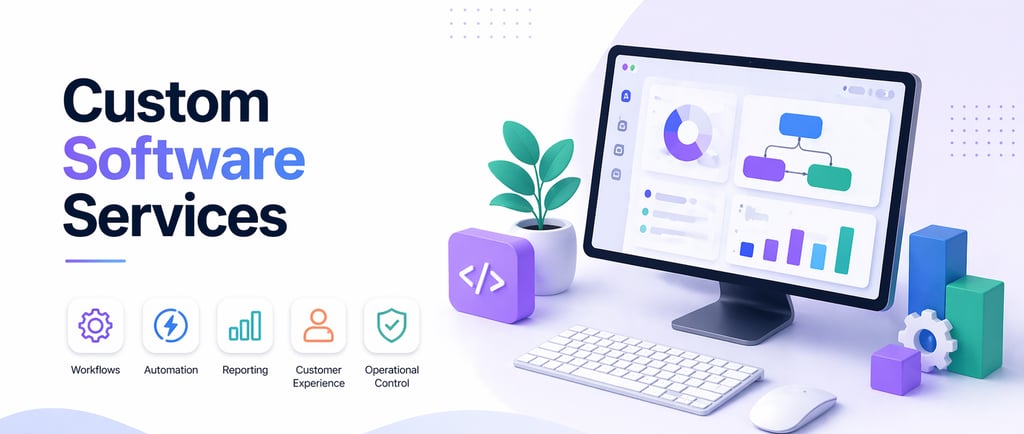
Why this topic needs a practical use-case angle
Custom software services are no longer just for big organisations with big, complicated IT departments. By 2026, customised software is helping small, mid-sized, and multinational organisations overcome actual operational difficulties like sluggish approvals, dispersed customer data, manual reporting, disconnected accounting tools, poor document tracking, and repetitive employee duties.
The market is behind this change. Global Market Insights states that the bespoke software development market was valued at $44.2 billion in 2025 and is expected to reach $50.6 billion in 2026, with a predicted value of $213.4 billion by 2035. That increase is tightly linked to the demand for specialised software and enhanced customer experience.
Why off-the-shelf software is not enough for enterprises
Most companies start with the tools that are ready-made, because they are quick and easy. One company might have one platform for accounting, one for CRM, one for project tracking, one for payroll and then a handful of spreadsheets for reporting.
At first sight it looks simple. Yet as the organization scales, these tools’ separation starts creating hidden concerns. Employees duplicate the same data across several systems. The managers are waiting for the new reports. Documents are sent by e-mail by the customer. Finance teams manually verify payment status. HR staff manage requests via spreadsheets. Operations teams spend time chasing simple tasks.
That’s when corporations begin seeking specialised systems. The idea is not to replace every instrument. The idea is to link the most critical workflows so that the business runs with minimal friction.
This is a good positioning opportunity for Enter and Post LLC because businesses don’t just require software. They need real systems to allow business to happen every day.
What corporations really want from custom software
A company doesn't typically wake up and declare, “We need a custom platform.” Usually it hurts first.
The discomfort could be delayed approvals, missing paperwork, duplicate work, unclear customer communication, bad reporting, or employees spending too much time on repetitive tasks. When these difficulties occur on a daily basis, you are losing money, even if it is not reflected in one bill.
That’s where custom software services come into play. This allows for the creation of a bespoke system which conforms to the company's real workflow, instead of the firm having to adapt its process to fit a generic tool.
Imagine a service business where a customer portal is needed, where customers input papers, employees review them, supervisors approve the work, and the system automatically distributes updates. A generic tool may handle one piece of the puzzle, but a specialised system can tie it all together.
Use case 1: Accounting and book-keeping processes
Accounting and accounting organisations are often required to deal with repetitive document requests, client follow-ups, invoice monitoring, approvals, reports and sensitive financial information. These duties are often done using emails and spreadsheets and delays are usual.
A custom system can organise client data, send reminders, track missing documents, display payment status, allocate tasks to team members, and provide reports for management. It can also reduce the number of manual follow-ups between clients and accounting personnel.
This is particularly handy for organisations dealing with multiple clients at once. No more digging through email threads, the team can view client status all in one dashboard.
It’s a logical fit for Enter and Post LLC, because accounting, payroll, HR and business process knowledge can help build software that works for real administrative needs, not simply technical requirements.
Use case no 2 : HR and Payroll processes
HR and payroll divisions maintain sensitive employee data, onboarding documentation, leave requests, attendance data, approvals, payroll changes, and compliance-related records. These procedures are more prone to error when they are distributed.
You may build a bespoke HR workflow system where employees can file requests, supervisors can approve, HR teams can track documents, and payroll teams can get clear information. It can also assist managers who have access to sensitive information.
This kind of software enhances more than velocity. It makes it more accountable. Everyone can see what has been submitted, who has examined it, and what is remaining to be done.
This is increasingly significant in firms with remote or hybrid teams. This centralised approach lowers the need for manual communications and enhances visibility.
Use case 3 Customer portals for service companies
Many service organisations spend time answering the same consumer enquiries over and over again. Customers want to know what’s happening with their request, what documents are needed, when work will get done or if payment’s been received.
This can be solved with a personalised customer portal that gives the client a secure area to submit files, check on updates, make requests, view bills and connect with the business.
This enhances the customer experience, as customers no longer have to wait for email replies. Also, it takes the load off internal teams as general updates are posted in the portal.
Customer experience is a key reason why organisations are investing in tailor-made software. The market for custom software is expanding as firms seek systems that better fit the needs of customers and the flow of business.
Use case 4: Operations dashboards and reports
Visibility is one of the most prevalent problems that growing businesses face. The owner or management may not realise how many jobs are pending, which clients are behind, which payments are overdue or which personnel are overwhelmed.
A bespoke dashboard can give you valuable data all in one location. It can show task status, client activity, payment updates, employee performance, service delays and workflow bottlenecks.
This lets leaders make faster decisions. Managers can view data in real-time or near real-time, rather than waiting for weekly manual reports.
The bespoke software development market is anticipated to rise from $53.95 billion in 2025 to $65.85 billion in 2026, with demand stemming from industries like BFSI, healthcare, IT, telecom, manufacturing, retail and government, according to The Business Research Company. This indicates that diverse industries are employing custom software to better their operational control.
Use case 5: Automating repetitious work
One of the biggest reasons firms invest in custom systems is to automate. You might need automatic reminders, task assignments, status updates, invoice alerts, document checks or approval notifications.
The value of automation is more than just saving time. It also decreases the likelihood of missing critical stages.
If, for example, the client has not uploaded a required document, the system can send a reminder message. If an invoice is overdue, the system can send notification to finance staff. If a request is approved by a manager, the next step might be allocated automatically.
Digital transformation continues to be a top corporate goal 2026, with many organisations investing in AI, hybrid cloud and analytics to better business operations. Custom systems are used to make that transformation into real, everyday improvements.
Why AI is becoming part of custom software
AI is now changing how businesses think about workflow systems. Companies seek software that can summarise papers, offer next steps, identify missing information, support customers and improve reporting.
AI, however, is at its best when there are pre-existing, structured workflows and clear data. When information is distributed over emails, spreadsheets and separate applications, the AI features may not give accurate results.
A custom system can lay the framework for AI, with suitable data organization, user access controls, and integration of key business processes. This way AI can assist the workflow instead of creating confusion.
The practical goal for companies working with Enter and Post LLC shouldn’t be to “add AI everywhere.” A more useful goal is to see where AI can save you time, minimize manual work, and help you make better decisions without increasing risk.
Why outsourcing remains on the agenda
There are a lot of firms who don’t have an in-house software staff. This is why they use external vendors to design, build and maintain unique systems.
Mordor Intelligence projects the software development outsourcing industry to be valued at $618.38 billion in 2026, up from $564.22 billion in 2025, and to reach $977.04 billion by 2031.
That is to say, businesses are comfortable turning to external software partners when they need technical expertise, faster delivery or flexible development support.
But the partner is important. A business is not merely about technological talents. Look for a partner who understands workflow, communication, security, scalability and long term maintenance.
What to include in a custom software project
A major custom software project should involve discovery, planning, design, development, testing, launch, and support.
Discovery helps to find the real business problem. Planning discriminates between what is necessary and what can wait. Design. Layout user experience, workflow, permissions and data structure. Development is the process of turning the plan into a working system. Testing is the process of checking if the system is working appropriately. Support makes the software useful after the launch.
A good project may include:
● workflow mapping
● user role planning dashboard layout
● secure login admin control panel file management reporting capabilities
● third party integrations automation rules
● support post-launch
These aspects make the system practical, not merely functional.
Why Overbuilding Is Bad for Business
Trying to build every feature in the initial release is a big mistake. This adds cost, delays introduction and might make the system difficult to operate.
A better way is to design the most crucial workflow first. When real people start using the technology, the firm may improve it based on genuine input.
This staged method helps safeguard the money, and keeps the project on track.
How Enter and Post LLC fits in
Enter and Post LLC can present themselves as a pragmatic business software partner for businesses that seek to optimize operations, minimize manual work and design solutions around real workflows.
Many firms don’t need extremely complicated technologies. They require software that lets workers perform faster, customers interact easier, managers see better data, and operations function with fewer delays.
That is the true worth of custom software. It turns everyday business challenges into structured digital procedures.
Conclusion
Generic technologies don’t always do a good job of solving workflow difficulties for businesses, and that’s where custom software services come in handy. Whether the demand is for accounting automation, HR workflows, customer portals, dashboards, reporting or document management, the goal is the same: make corporate operations cleaner, faster and easier to handle.
The role of custom software in driving corporate success will only increase as organisations invest more in bespoke systems, AI-enabled workflows, cloud tools and automation.
Enter and Post LLC can assist, plan and develop a system tailored to real operational demands if your firm needs a client portal, internal dashboard, automation system, reporting tool or workflow-based software solution.
CTA
Looking to streamline your business processes with practical custom software? Talk to Enter and Post LLC today about your project and let us construct a solution for real workflows, real users and demonstrable business benefits.
Contact Us
Socials
📞 USA: (+1) 503-895-5745
📞 Pakistan: (+92) 332-3480678
🏢 Head Office:
Portland, Oregon, United States of America.
🏢 Back Office:
Karachi, Sindh, Pakistan.
© Copyright 2026 | Developed By | Enter and Post LLC