
Outsourcing HR moves the work, but it does not always move the legal responsibility. Even with a consultant or a professional employer organization (PEO), an Oregon employer still has obligations that depend heavily on how many people work for them.
This guide lays out what Oregon and federal agencies say employers owe at each headcount, what a PEO does and does not take off your plate, and how to match the kind of help to the problem. It is general information, not legal advice; check the agency pages linked below for your own situation.
Key Takeaways
- With even one employee, Oregon already requires protected sick time, bars salary-history questions, and sets deadlines for final paychecks, and federal law requires a Form I-9 for every hire.
- Obligations step up sharply by headcount: at 6 employees (Portland rules, plus a statewide pregnancy-accommodation notice), 10 (Oregon paid sick time), 15 and 20 (federal discrimination laws), 25 (the Paid Leave Oregon employer share), and 50 (FMLA).
- The IRS says a business that outsources payroll generally remains responsible for paying taxes and filing returns, and that using an IRS-certified PEO (a CPEO) affects the liabilities of both sides, so ask what your PEO’s certification means for you.
- Compare written quotes and written division-of-duties contracts rather than relying on headline cost savings.
In this article:
- • Your Headcount Decides What You Owe
- • What Applies Even With One Employee
- • Portland-Specific Rules
- • A Hypothetical: Growing From Five to Seven
- • What a PEO Does and Does Not Take Off Your Plate
- • Before Your First Hire
- • When In-House Makes Sense
- • Matching the Fix to the Problem
- • Questions to Ask Before You Sign
- • What It Costs
- • Frequently Asked Questions
- • How to Decide
Your Headcount Decides What You Owe
The table below collects thresholds from official pages as of October 2026. The counting rules differ by law: Oregon sick time averages headcount over 20 workweeks of the prior year, the federal discrimination laws count employees across 20 or more calendar weeks, and Paid Leave Oregon uses an average. The 6-employee rows and Paid Leave Oregon’s “on average” test have their own counting methods on the agency pages. Check each agency’s method before you assume you are over or under a line, and note that this table is not a complete list: it omits other Oregon rules, including state family-leave and state anti-discrimination law, which have their own thresholds.
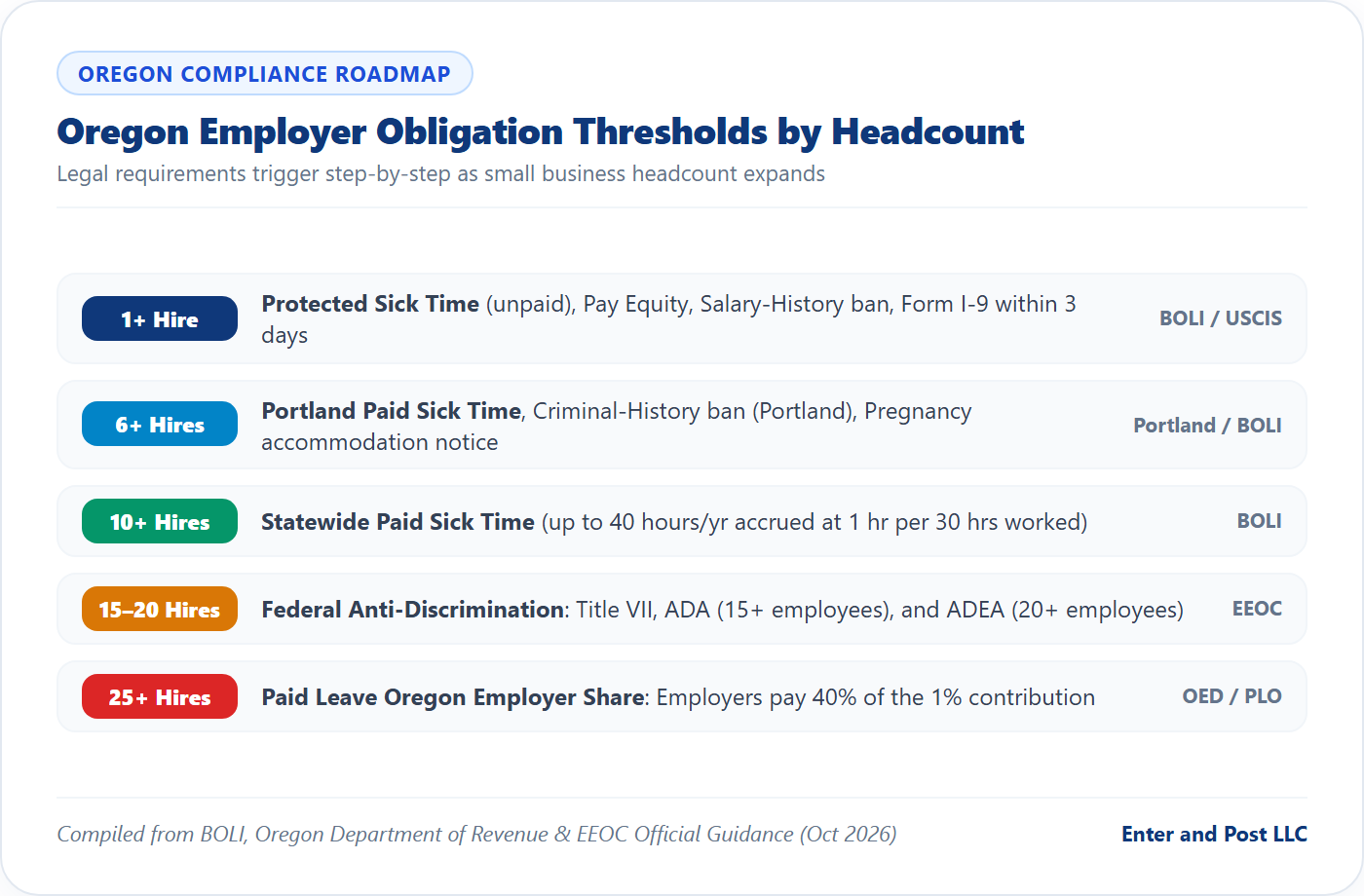
| Employees | What applies | Source |
|---|---|---|
| 1 or more | Oregon protected sick time (unpaid below the paid thresholds); pay equity and salary-history rules; Form I-9 for every hire | BOLI sick time, BOLI equal pay, USCIS |
| 6 or more (Portland) | Paid sick time for employers with a Portland location, and the Portland criminal-history ordinance for jobs mostly performed in Portland | BOLI sick time, BOLI hiring |
| 6 or more (statewide) | Oregon pregnancy-accommodation notice: employers must post signs about the right to be free from pregnancy-related discrimination and to reasonable accommodation | BOLI postings |
| 10 or more | Oregon paid sick time statewide | BOLI sick time |
| 15 or more | Title VII and the Americans with Disabilities Act (ADA) | EEOC |
| 20 or more | Age Discrimination in Employment Act (ADEA) | EEOC |
| 25 or more (on avg) | Paid Leave Oregon employer contribution: for 2026, large employers pay 40% of the 1% total rate, which applies to wages up to an annual cap | Paid Leave Oregon |
| 50 or more | FMLA employer coverage | DOL |
| 500 or more (worldwide) | Oregon predictive scheduling, for retail, hospitality, and food services (rarely relevant to a small employer) | BOLI |
Two cautions. The Paid Leave Oregon rate is for 2026 and resets each year, and employers below 25 employees on average do not pay the employer share but must still withhold the employee share. Our Portland payroll tax guide covers how that withholding works.

What Applies Even With One Employee
Several rules apply from the first hire, whether or not you use outside help:
- Final paychecks: BOLI says a final paycheck is due by the end of the next business day if an employee is let go, on the last day if the employee quits with at least 48 hours’ notice, and within five business days if the notice is shorter. Check BOLI’s page for the exact rules and exceptions (BOLI).
- Salary history: Employers may not ask for a worker’s pay history before making an offer, or screen applicants on current or past pay (BOLI).
- Age questions: Since September 26, 2025, employers generally may not ask applicants for their age or date of birth until an interview is complete or a conditional offer is made (BOLI).
- Records retention: BOLI says personnel records must be kept at least 60 days after termination, time records two years, and payroll records three years, and that records must be produced within 45 days of an employee’s request (BOLI).
- Form I-9: Every U.S. employer must complete Form I-9 for each hire, with the employer section finished within three business days of the date of hire (USCIS).
These are exactly the tasks people hope to hand off. Whoever does them, the employer is the one the agencies look to if they are missed. For tax payments and returns, the IRS says a business that outsources payroll generally remains responsible.
Portland-Specific Rules
For jobs performed mostly in Portland, BOLI says the city’s ordinance covers any employer with six or more employees, and that criminal history may be considered only after a conditional offer of employment (BOLI). BOLI also says sick time is paid for employers with 10 or more Oregon employees, or six or more if they have a location in Portland, and that smaller employers must still allow unpaid protected sick time without discipline (BOLI).
If you are approaching your sixth employee in Portland, that is a good time to review your application forms and sick-time policy, and to check BOLI’s counting method.
A Hypothetical: Growing From Five to Seven
This is an invented example to show how the thresholds work; it is not a legal conclusion about any real business.
Case Study: Portland Coffee Roaster Scaling Headcount
Imagine a Portland coffee roaster with five employees. It owes protected sick time (unpaid, because it is under the paid thresholds), may not ask applicants about pay history before making an offer, and must complete a Form I-9 for each hire. Once it reaches six employees, BOLI’s pages indicate that the Portland criminal-history ordinance covers it for jobs performed mostly in Portland, and that its sick time may become paid, depending on how BOLI counts employees over time.
Nothing about the business changed except headcount, yet its application form and sick-time policy are worth reviewing.
That is a common moment to consider outside help, in the author’s view, and it is a useful test: could you describe, in one paragraph, which of these rules apply to you today? If not, that gap is the problem to solve first, whether with a consultant, a PEO, or a few hours of your own reading.
What a PEO Does and Does Not Take Off Your Plate
Oregon’s Workers’ Compensation Division says a PEO becomes the employer of record for certain obligations, typically payroll and employment taxes, with workers’ compensation among them, and that PEOs must be licensed in Oregon before providing worker leasing. As of October 2026, its licensing page lists a $2,050 fee, with the license valid for two years unless renewed; the fee is paid by the PEO. Check the division’s pages for current terms (Oregon WCD). The same division says temporary staffing does not require that license (Oregon WCD).
The federal picture is less tidy, and the IRS guidance below is general third-party-payer guidance rather than a small-business PEO guide. The IRS says the concept of a “co-employer” is not recognized under federal tax law, and that a business outsourcing payroll to a third party generally remains responsible for paying taxes and filing returns (IRS). The IRS also says that an agreement with a Certified Professional Employer Organization (CPEO) affects the employment tax liabilities of both the CPEO and its customers (IRS). In practice, ask any PEO whether it is IRS-certified and get its liability terms in writing.
Before Your First Hire
If you have never employed anyone, a short checklist beats a large project. These are starting points, not a complete compliance list:
- Register as an employer and set up payroll: Our Portland payroll tax guide lists what you pay and what you withhold.
- Decide whether the worker is really an employee: The virtual assistant guide explains the Oregon tests.
- Prepare your interview questions so they avoid salary history and, until the interview is complete or an offer is made, age.
- Have your Form I-9 process ready before the start date.
- Decide where you will keep personnel, time, and payroll records, using BOLI’s retention periods above; Form I-9 has its own retention rule, which USCIS describes as three years after hire or one year after employment ends, whichever is later.
- Ask about workers’ compensation coverage: The payroll guide above covers what Oregon employers pay and withhold.
When In-House Makes Sense
This section is the author’s judgment, not research data. Handling HR yourself, or through a manager who owns it, tends to fit when the volume is low, the decisions are mostly judgment calls about people you know, and you want one accountable person. A dedicated in-house hire tends to make sense once HR work is steady enough to fill a role and mistakes would be costly, for example when several of the thresholds above start to apply at once.
A simple rule of thumb, again the author’s judgment: if you can name HR tasks that recur every week and that only you or one trusted person can do, that points toward keeping an owner in-house; if the tasks are occasional or rule-heavy, that points toward outside help.
Outsourcing tends to fit when the work is repetitive administration, when you need specialist knowledge for a short period, or when you cannot afford to be wrong on a rule you rarely handle. One common approach is to mix the two: keep decisions and relationships in-house, and buy administration or legal review from outside.
Matching the Fix to the Problem
The table below is the author’s judgment, not research data. It maps common HR needs to the kind of help that usually fits.
| HR need | Often fits | Why |
|---|---|---|
| Finding and screening candidates | Recruiter, or in-house | Hiring-only work with a clear end point |
| Handbook and policy drafting | HR consultant | One-time or periodic advice |
| Payroll, benefits, and workers’ comp administration | PEO or payroll software | Ongoing administration |
| “Is this legal?” questions | HR consultant or an attorney | Needs current legal knowledge |
| Performance problems and terminations | You, with advice | Judgment and accountability stay with the employer |
Software can also cover part of this; see our guide to choosing business software. And if the help you have in mind is one person doing admin work remotely, our virtual assistant guide explains why contractor or employee status depends on the facts.
Questions to Ask Before You Sign
Whether you are talking to a PEO, a consultant, or a recruiter, these questions surface the terms that matter most:
- What exactly will you do, and what stays with me? Ask for the split in writing, task by task.
- Who is responsible if something is filed or paid late? The IRS points out that a client that outsources payroll generally remains responsible for taxes and returns, so the contract should say how mistakes are handled.
- Are you licensed or certified? For a PEO, ask about its Oregon license and whether it is an IRS-certified CPEO.
- What does it cost, in total? Ask for every fee, including setup, per-employee charges, and any charge for leaving.
- How do I leave? Ask what happens to your records, payroll history, and benefits enrollment if you end the arrangement.
- Who answers my questions, and how fast? The person you talk to on day 200 matters more than the person who sold you the service.
A provider that answers these plainly is easier to trust than one that leads with a savings claim you cannot check.
What It Costs
This research found no credible, neutral source for PEO fees, recruiter fee percentages, fractional HR rates, or HR cost per employee. The figures online come from vendor and consultancy pages, so this guide does not repeat them. Ask each provider for a written fee schedule, including what happens if you leave, and compare it against the time you spend on HR today.
Frequently Asked Questions
Do I need an HR department with only a few employees?
Not necessarily, but the legal obligations start with the first hire. Oregon sick time, salary-history rules, and final-paycheck deadlines apply to small employers, so someone has to own them, whether that is you, a consultant, or a PEO.
Does a PEO take over my legal responsibility?
Not automatically. The IRS says a business that outsources payroll generally remains responsible for paying taxes and filing returns, and that an agreement with an IRS-certified PEO (a CPEO) affects the liabilities of both sides. That guidance is general rather than specific to small-business PEOs, so get the allocation of responsibility in writing and ask whether the PEO is certified.
Is a PEO licensed in Oregon?
Oregon requires PEOs to be licensed before providing worker leasing services. The Workers’ Compensation Division’s licensing page is the place to start when checking a provider.
When do federal laws like FMLA start to apply?
FMLA applies to private employers with 50 or more employees for at least 20 workweeks in the current or preceding calendar year, while Title VII and the ADA start at 15 employees and the ADEA at 20.
How to Decide
Start with your headcount and the table above, so you know what you owe. Then list the HR tasks that cost you the most time or carry the most risk, and match each to the kind of help in the second table. Whatever you outsource, keep the decisions that carry legal accountability close, and get any PEO or consultant arrangement in writing before you sign.
Photos via Pexels: fauxels, Tima Miroshnichenko, ANTONI SHKRABA production, and Kampus Production.