

Handing admin work to a virtual assistant feels like a staffing decision, but in Oregon it is also a legal one. A person you call a “virtual assistant” or a contractor can still be your employee in the eyes of the state, and the label on the contract does not decide it.
This guide helps small business owners sort back-office tasks, compare a virtual assistant with software or an employee, and understand the classification tests that apply in Oregon. It is general information, not legal advice; for a specific worker, check the state’s own resources linked below.
In short: send rule-based tasks to software first, keep anything involving money or sensitive access close to you, and let Oregon’s classification tests, not the job title, decide whether a helper is a contractor or an employee. This guide does not quote virtual assistant rates, because this research found no neutral source for them.
Key Takeaways
- Under Oregon’s guidance, a contract that says “independent contractor,” a Form 1099 instead of a W-2, or an LLC the worker formed does not by itself settle whether they are a contractor.
- At least three different tests can apply to one worker in Oregon, and passing one does not clear the others.
- In Intuit’s survey and QuickBooks data, 77% of U.S. businesses used AI regularly as of January 2026, with adoption highest in marketing, admin, and customer service, so software and AI are real alternatives to a virtual assistant for some tasks.
- Give any outside helper access only to what the job needs, and only for as long as it is needed.
In this article:
- • Sort Your Back-Office Tasks First
- • Software and AI as the Alternative
- • Is Your Virtual Assistant a Contractor or an Employee?
- • What Oregon Adds for Contractors You Do Pay
- • What It Costs
- • Two Hypothetical Arrangements
- • When an Employee Is the Better Fit
- • Protecting Your Systems and Customer Data
- • A Simple Handoff Checklist
- • Frequently Asked Questions
- • How to Decide
Sort Your Back-Office Tasks First
Start with the work, not the worker. List the recurring tasks that pull you away from customers, then ask what each one needs: judgment, access to sensitive systems, a fixed process, or a human relationship.
The table below is the author’s judgment, not research data. Use it as a starting point for your own list.
| Task type | Often suits | Why |
|---|---|---|
| Scheduling, reminders, inbox sorting | Software or AI, or a virtual assistant | Repeatable and rule-based |
| Data entry, document formatting | Virtual assistant or software | Low judgment, clear instructions |
| Customer email and chat replies | Virtual assistant, with a script and review | Needs a consistent voice and some judgment |
| Invoicing and bookkeeping support | Software first, with oversight | Touches financial records and tax reporting |
| Anything with banking or payroll access | You or a trusted employee | Highest risk if something goes wrong |
If a task is mostly a matter of rules, software may do it without a person. Our guide to choosing business software covers how to evaluate those tools, and our bookkeeping fundamentals explain which financial work should stay close to you.

Software and AI as the Alternative
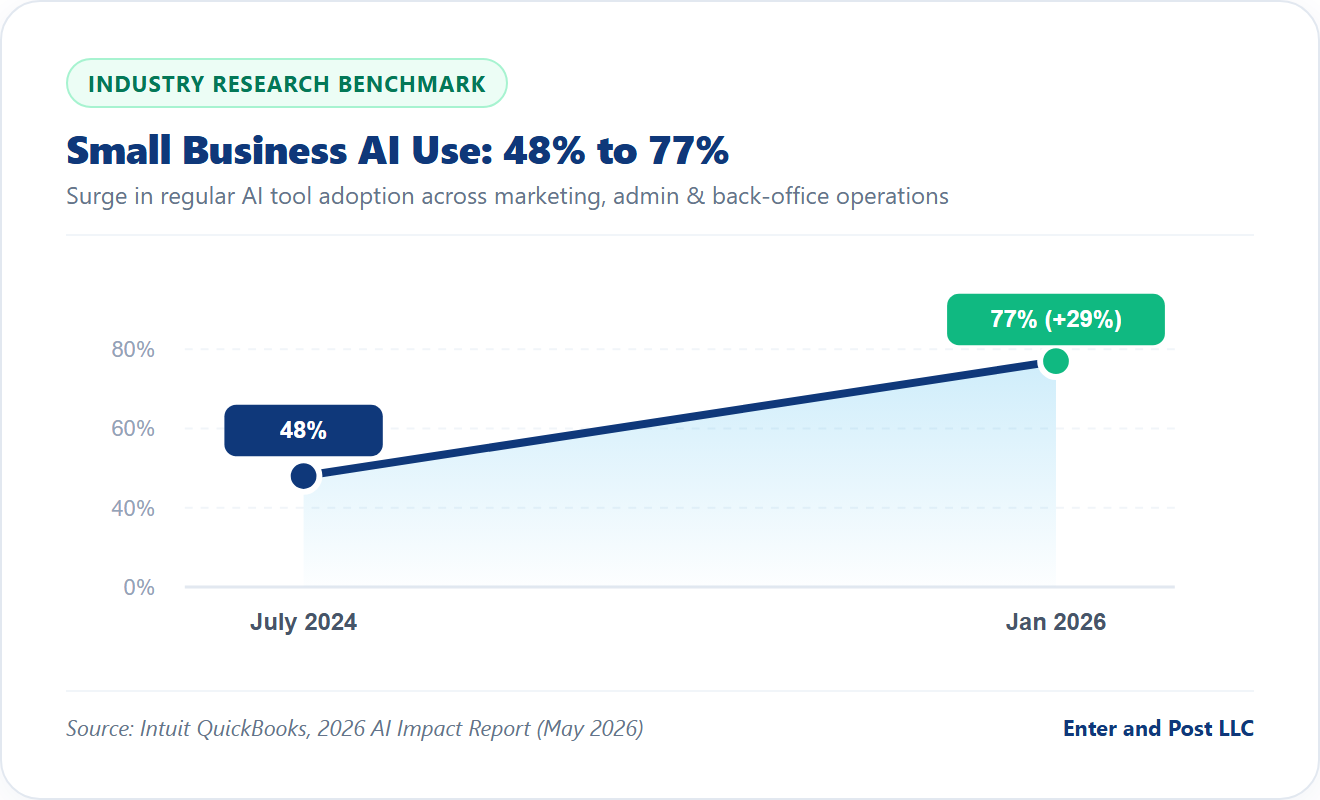
Intuit reports that 77% of U.S. businesses in its survey and QuickBooks data used AI regularly as of January 2026, up from 48% in July 2024, and that adoption is highest in marketing, admin, and customer service (Intuit QuickBooks, 2026 AI Impact Report). Intuit’s definition of regular use includes free tools, built-in features, and paid subscriptions, so the figure is broader than “businesses that bought an AI assistant.”
The practical point is that some tasks you might hand to a virtual assistant are now handled by tools you may already pay for. Check what your existing software can do before you hire anyone. A person still makes sense where the work needs judgment, relationships, or tolerance for messy instructions.
Is Your Virtual Assistant a Contractor or an Employee?
The IRS looks at three categories of evidence: behavioral control, financial control, and the relationship of the parties, and says “no one factor stands alone.” What matters, in its words, is the right to control the details of how the services are performed (IRS).
Oregon adds its own rules. The Oregon Department of Revenue, the Employment Department, the Workers’ Compensation Division, and two contractor boards require that a worker meet all the criteria of ORS 670.600 to count as an independent contractor, while the Bureau of Labor and Industries (BOLI) uses different criteria (Oregon Independent Contractor guidance). The same page says that a contract label, reporting pay on a Form 1099, or the worker forming an LLC or corporation is not determinative by itself.
| Test | Who applies it | What it looks at |
|---|---|---|
| Common-law test | IRS | Behavioral control, financial control, relationship of the parties |
| ORS 670.600 | Oregon Department of Revenue, Employment Department, Workers’ Compensation Division, and contractor boards | Freedom from direction and control over how the work is done, an independently established business, and licensing where required |
| Economic realities | BOLI, for wage-and-hour claims | Six factors: integral work, control, permanence, skill and initiative, profit and loss, relative investment |
As paraphrased from a site that reproduces the statute, ORS 670.600 asks whether the worker is free from direction and control over the means and manner of the work, customarily engaged in an independently established business, and properly licensed where required (ORS 670.600). Read the official statute before relying on any summary, including this one.
BOLI’s page says its six economic-realities factors are weighed together and that no single factor is determinative (BOLI). By the IRS and BOLI factors above, an assistant who works set hours, follows your detailed instructions, and works only for you looks more like an employee than a business serving several clients; that is this guide’s reading, not a ruling. If that describes your arrangement, our Portland payroll tax guide covers what employing someone triggers.
What Oregon Adds for Contractors You Do Pay
If a worker really is a contractor, a few obligations remain. The Oregon Department of Revenue says Form 1099-NEC is filed through its iWire system, and notes that the IRS raised the reporting threshold for Forms 1099-MISC and 1099-NEC from $600 to $2,000 (Oregon DOR iWire). Track payments to each contractor through the year so you know when you cross it.
Contractors also sit differently under Paid Leave Oregon. The program says independent contractors are not automatically covered but can choose coverage (Paid Leave Oregon). For a contractor based in another state or country, this research found no primary Oregon or IRS source explaining how that changes your obligations, so ask a tax professional rather than assume.
What It Costs
This research found no neutral, citable source for virtual assistant hourly rates. The figures that appear online come mostly from agency and staffing-vendor pages without a disclosed method, so this guide does not repeat them. Get written quotes for your own scope.
For an employee benchmark, the Bureau of Labor Statistics reports median pay for secretaries and administrative assistants of $48,310 a year, or $23.23 an hour, as of May 2025 (BLS). That covers wages only, not employer taxes or benefits, and it is not a virtual assistant rate.
Two Hypothetical Arrangements
These are invented examples to show how the factors play out; they are not legal conclusions about any real worker.
Arrangement A: High Control (Looks Like an Employee)
A Portland bakery owner hires one person to answer customer email from 9 to 1 every weekday, using the bakery’s email account and following a written script. The owner reviews every reply, sets the schedule, and the person works for no one else. On the factors above (control over how and when the work is done, an ongoing relationship, no independent business), this looks closer to an employee, and the contract label alone would not settle it.
Arrangement B: Independent Business (Looks Like a Contractor)
A bookkeeping-support business with several clients agrees to reconcile the bakery’s invoices each month for an agreed fee. It chooses its own hours and tools, supplies its own equipment, markets to other clients, and the bakery specifies only the result. This looks closer to an independent business, though it would still need to meet every criterion of each test that applies. ORS 670.600 has further requirements, and BOLI weighs different factors, so the answer could still differ.
The difference is not the job title. It is who controls the details of the work and whether the worker runs a real business of their own.
When an Employee Is the Better Fit
An employee makes more sense when you need to direct the work closely or set the hours. Control over how and when the work is done is what the classification tests weigh, so trying to fit that kind of arrangement into a contractor label is where the legal risk builds. Ongoing access to sensitive systems is a separate, security-based reason to prefer an employee you can train and supervise.
The cost picture changes too. The BLS wage above is only the starting point, because employing someone adds costs beyond wages. See our payroll tax guide for Portland employers for what an Oregon employer pays and withholds. No source in this research puts a reliable total cost on an employee versus a virtual assistant, so compare written quotes and your own payroll numbers rather than a headline figure.
Protecting Your Systems and Customer Data
Any helper with access to your email, accounts, or customer records is a vendor risk. The Federal Trade Commission says vendors may have access to sensitive information about your business or customers, and advises: “Limit access to a need-to-know basis, and only for the time the vendor needs to do the job.” It also says: “Don’t just take their word for it” (FTC).
For a virtual assistant, that means separate logins rather than shared passwords, access limited to the tools the task needs, and removing access the day the engagement ends.
A Simple Handoff Checklist
Whoever does the work, a written handoff reduces mistakes and makes it easier to see how much control you are exercising:
- Write each task as an outcome. “Inbox sorted by 10 a.m.” is clearer than “help with email.”
- List the tools and the access each one needs, and nothing more.
- Define what needs your approval, such as refunds, anything involving money, or messages to key customers.
- Set a review rhythm, for example a weekly check of a sample of the work.
- Decide how the engagement ends, including removing access and collecting any files.
If writing the instructions reveals that you want to dictate hours, methods, and tools in detail, that is a signal to revisit the classification question before you start.
Frequently Asked Questions
Is a virtual assistant an employee or a contractor?
It depends on the facts, not the label. Oregon’s guidance says a contract label, a Form 1099, or an LLC is not determinative by itself, and more than one test can apply. An assistant you direct closely and who works only for you is more likely to be treated as an employee.
Do I need to file a 1099 for a virtual assistant?
If a worker is a contractor and you pay them $2,000 or more in a year, Form 1099-NEC reporting applies under the current threshold, and the Oregon Department of Revenue says it is filed through iWire. Confirm the current rules with the IRS and the Oregon Department of Revenue.
Can software or AI replace a virtual assistant?
For rule-based work like scheduling and inbox sorting, often yes. Intuit reports adoption is highest in admin and customer service. Tasks that need judgment or relationships still suit a person.
How should I give a virtual assistant access to my systems?
Use separate logins, grant only the access the task needs, and remove it when the work ends, in line with the FTC’s need-to-know guidance.
How to Decide
List your tasks, send the rule-based ones to software first, and keep anything involving money or sensitive access close to you. If you still want a person, decide up front whether the role is a true independent business or an employee-style arrangement, because Oregon’s tests turn on the facts, not the title. When in doubt, use the state’s contractor resources or a professional before the first payment.