
91% of U.S. adults own a smartphone (Pew Research Center, Mobile Fact Sheet, 2025). That makes “our customers are on their phones” a safe assumption, and it leads many owners to the wrong next step. Customers being on their phones does not mean they want to install your app.
This guide gives Portland small business owners a way to decide whether a custom app is worth building at all, what other businesses report spending, and which cheaper options solve the same problem. It does not cover how to vet agencies; for that, see our guide to hiring a web developer in Portland.
Key Takeaways
- Just over half of small businesses with an app reported spending $30,000 or less, and among the smallest firms (1 to 10 employees) 84% did, per Clutch’s summary of its survey.
- Clutch’s overall average app project cost ($90,780) is much higher than its typical range ($10,000 to $49,999), likely because larger projects skew the average.
- Most small business websites are built with no-code or low-code tools (41% and 34%), which suggests owners lean toward builders when they exist and makes a no-code app a sensible first test.
- Apple’s Small Business Program lowers its commission to 15% for developers under $1 million in proceeds, but store fee rules are still shifting.
- Start with the cheapest option that solves one specific customer problem, and graduate to a custom app only when that option clearly hits a ceiling.
In this article:
Start With the Problem, Not the App
The most useful question is not “should we have an app?” but “what specific thing do customers struggle to do today?” A bakery whose customers want to pre-order and skip the line has a concrete problem. A bakery whose owner simply feels a business “should” have an app does not.
A quick test: write the problem as one sentence, then check whether something you already pay for solves it. If your payment processor, booking tool, or e-commerce platform already offers a customer-facing app or mobile checkout, that is likely to be cheaper and faster than a custom build, though it is worth comparing quotes. Our guide to choosing business software covers how to evaluate those tools before you commit.

A custom app starts to make sense when three things are true at once: customers need to do something repeatedly, that action benefits from phone features such as push notifications or the camera, and no existing platform handles it well. If any of the three is missing, a mobile-friendly website or a third-party platform usually wins.
What Small Businesses Actually Spend
The chart in this section shows what business owners who already built an app reported spending. It leaves out businesses that decided not to build, the underlying survey dates to 2022 with a 2025 update, and the percentages are rounded.
Cost guides from agencies quote wildly different ranges, so the most useful data is what small businesses themselves report. In a Clutch and The Manifest survey of small business owners who had built an app, 33% spent under $10,000, 20% spent $10,001 to $30,000, 14% spent $30,001 to $50,000, 16% spent $50,001 to $100,000, and 16% spent more than $100,000. Among companies with 1 to 10 employees, 84% spent $30,000 or less, per Clutch’s summary of the updated results (Clutch / The Manifest).
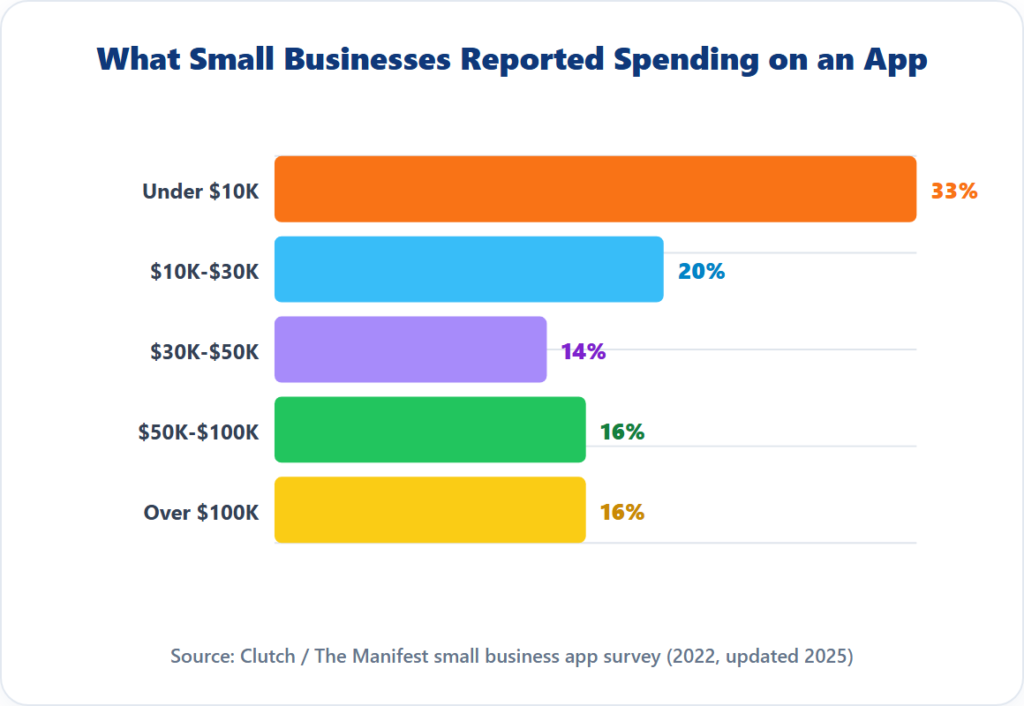
Treat these percentages as a rough shape rather than current pricing.
Clutch’s pricing guide shows how an average can mislead. It reports an average app project cost of $90,780 and an average duration of about 11 months, yet a typical range of $10,000 to $49,999 (Clutch, App Development Pricing Guide, Sept. 2026). Larger projects likely pull the average well above what most small businesses pay. Clutch is a marketplace that connects buyers with agencies and earns from that business, so treat its figures as industry-reported data rather than a neutral measurement. Clutch does not publish simple, mid, and complex cost tiers, and agency pages that do are marketing estimates, so this guide does not repeat them.
No-Code Is Already the Default for Websites
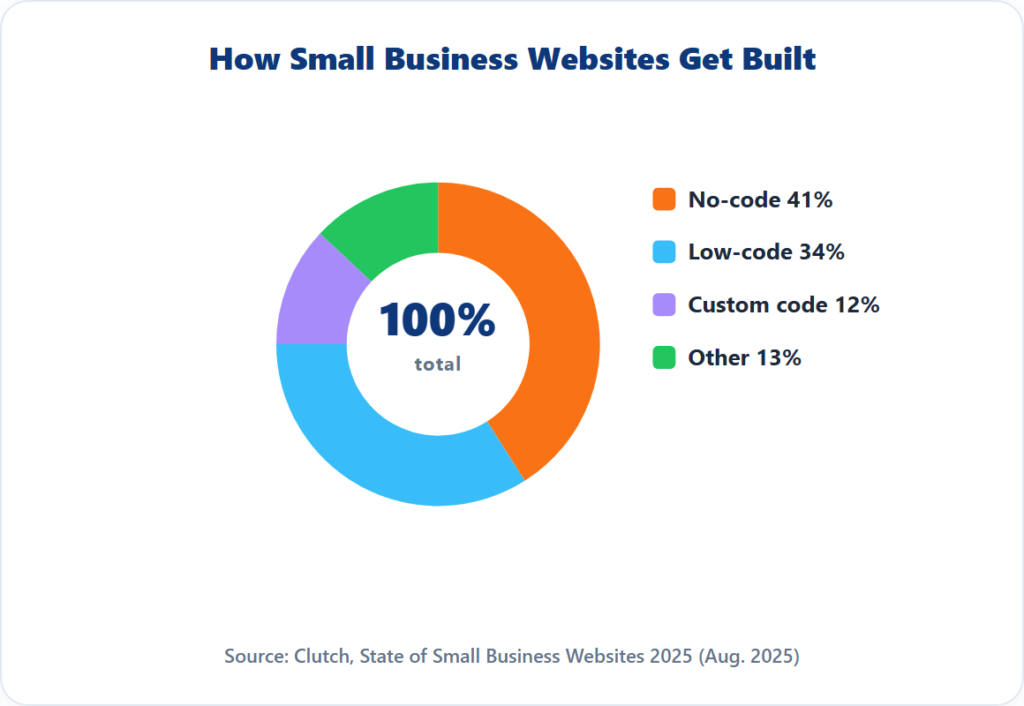
Small businesses have already shown how this plays out on the web. In Clutch’s 2025 survey of 406 U.S. small business owners, 83% had a website, and of those, 41% built it with no-code tools like Wix or Squarespace, 34% used low-code platforms like WordPress or Shopify, and only 12% used custom code (Clutch, State of Small Business Websites 2025, Aug. 2025). That survey did not measure mobile apps, so it cannot tell us app adoption. It does show which way small business owners lean when a cheaper builder exists.
That pattern is one reason to look at no-code app builders first. They are not right for every project, and they tend to hit limits on custom logic, performance, and ownership of your code. But for a loyalty program, an ordering flow, or a simple booking tool, starting there lets you test whether customers actually use the thing before you spend custom-build money.
Native vs. Cross-Platform
If you do build custom, the next decision is how. A native app is written separately for iPhone and Android, which means two separate codebases. A cross-platform approach shares most of the code across both. Flutter and React Native are two widely used cross-platform frameworks, and in the 2024 Stack Overflow Developer Survey they were roughly tied: Flutter was used by 9.4% of all respondents and React Native by 8.4%, while among professional developers the figures were 9.4% and 9.0% (Stack Overflow Developer Survey 2024).
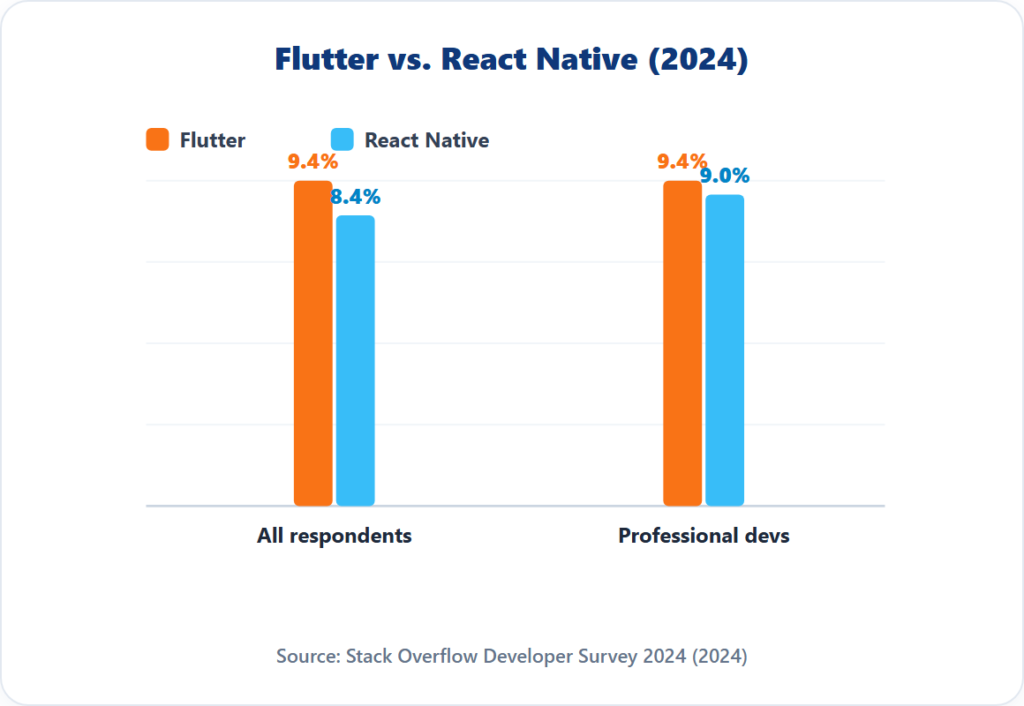
The takeaway is that neither framework is a clear winner, so choose based on the team you can hire rather than on popularity. For many small business projects, cross-platform tends to be the cheaper route, because it avoids paying to build and maintain everything twice. Native becomes worth it when you need deep access to device features or top performance. Note that this survey data is from 2024 and measures developer usage, not which approach suits a small business.
App Store Fees in 2026
App stores take a cut of in-app sales, which matters if your app sells anything. Apple’s Small Business Program lowers its commission to 15% for developers with $1 million or less in annual proceeds, and new developers qualify automatically (Apple Developer).
Beyond that, the rules are still moving. App store rules in the United States have been changing, including what developers may do about linking out to outside payment methods, and Google says developers in its newer U.S. programs must report transactions and pay service fees as of October 1, 2026 (Google Play Help). Specific fee percentages for these newer programs were not available from a primary source at the time of writing, so check each store’s current terms before you build a business case around a particular rate. Changes to Apple’s European commission structure apply to the EU only, not to Portland businesses.
Alternatives to Building an App
Before committing to a build, compare the realistic alternatives:
- A mobile-friendly website: For information, menus, and contact details, a fast mobile site reaches customers without any install. Our web developer hiring guide covers what that costs.
- Third-party platforms: Payment, booking, and e-commerce platforms often include a customer-facing app or mobile checkout you can use immediately.
- A progressive web app (PWA): A PWA is a website that behaves like an app on a phone. It is a real option, but claims about its conversion lift often come from low-quality sources, so evaluate it with your developer rather than relying on headline numbers.
- A no-code or low-code app: Good for testing demand with a small budget.
| Option | Cost Direction | Time to Launch | Customer Must Install? | Best For |
|---|---|---|---|---|
| Mobile-friendly website | Lowest | Fastest | No | Menus, hours, contact, simple ordering |
| Third-party platform | Low (subscription/fees) | Fast | Sometimes | Payments, booking, e-commerce you already use |
| PWA | Moderate | Moderate | No (added to home screen) | App-like experience without app stores |
| No-code or low-code app | Moderate | Moderate | Yes | Testing a loyalty or ordering idea |
| Custom app | Highest | Slowest | Yes | Repeated customer actions that need device features |
This table is qualitative: costs and timelines vary by scope, and no reliable source publishes firm tiers for small businesses.
A custom app is the right answer when none of these cover the job. It is rarely the right first step.
Is Local Connectivity a Reason to Build?
Oregon households are well connected: 95.3% of them have broadband plus a computer, smartphone, or tablet, slightly above the 94.6% U.S. average (U.S. Census Bureau ACS 2024, via America’s Health Rankings). Access is rarely the barrier. Local help exists for the rest: in April 2025 the City of Portland announced Digital Navigator and Digital Transformation grants of $155,000 each to three organizations, including Micro Enterprise Services of Oregon (MESO), which is expanding digital advising on e-commerce, digital marketing, and financial management tools (City of Portland).
The real question is whether your specific customers would choose your app over a mobile site or a platform they already use. If you do build, track the project as a real business expense: our bookkeeping fundamentals and Portland small business tax guide explain how those costs and any in-app revenue fit into your records and taxes.
Frequently Asked Questions
Does my small business need a mobile app?
Usually not as a first step. If a mobile-friendly website or an existing platform already lets customers do the one thing you care about, a custom app adds cost and maintenance without much gain. Build one only when customers need to repeat an action and no existing option handles it well.
How much does a small business app cost?
It varies widely. In a Clutch and The Manifest survey, a third of small business owners with an app spent under $10,000, and, per Clutch’s summary, 84% of firms with 1 to 10 employees spent $30,000 or less. Clutch’s overall average is much higher, at $90,780, because large projects skew it upward.
How long does it take to build an app?
Clutch reports an average of about 11 months across its projects, but that includes large builds. Simple apps can take less time, and no reliable source gives firm timelines by complexity, so ask any developer for a written estimate tied to a specific scope.
Is no-code good enough for a small business app?
For testing an idea, a loyalty program, or a simple booking flow, often yes. Most small business websites are already built with no-code or low-code tools. The tradeoffs are limits on custom features, performance, and owning your code.
How to Decide
Whether to build an app comes down to one question: is there a specific, repeated customer action that no cheaper option handles well? If not, a mobile-friendly site or an existing platform will likely serve you better. If yes, start small, test demand with a no-code or cross-platform build, and spend on custom development only after customers prove they will use it.